Warehouse storage systems are the racking, shelving, automation and software that determine how much you can store, how quickly you can retrieve it, and how efficiently your space is used. They range from conventional pallet racking and shelving through to fully automated storage and retrieval. The right choice depends on your products, order profile, throughput and building, and most operations combine several types. MotionTech designs, manufactures and integrates complete warehouse storage systems for businesses across the UK, from a single racking installation to a fully automated facility.
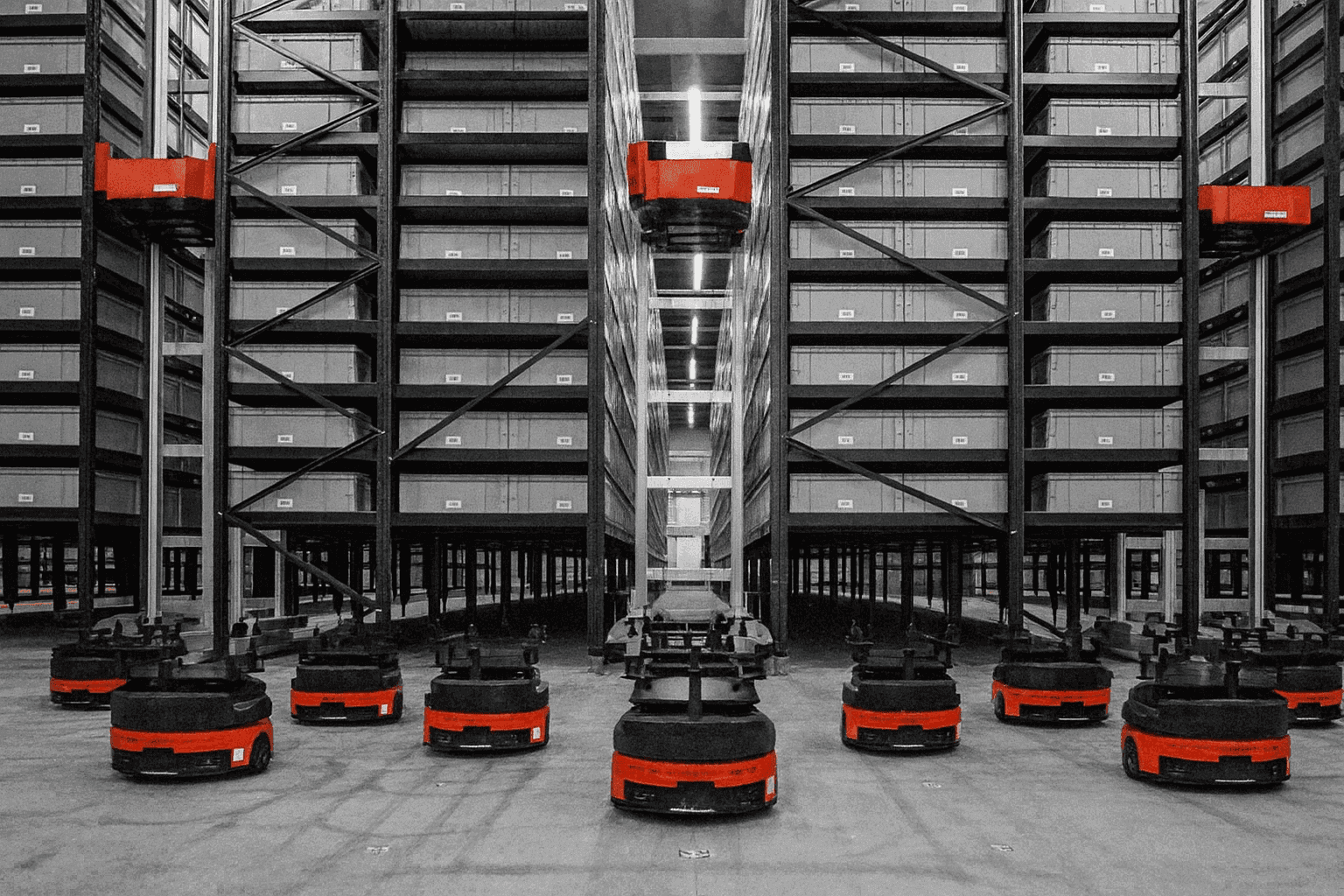
Warehouse Storage Systems
Complete warehouse storage systems designed, built and integrated for UK operations, from automated racking to fully automated storage and retrieval.
Types of Warehouse Storage Systems
There is no single warehouse storage system. The main types, from conventional through to fully automated, are:
- Pallet racking and high-bay storage: the backbone of most warehouses. Selective, drive-in, push-back and mobile racking each trade density against accessibility, letting you store more pallets in the same footprint.
- Shelving and small-parts storage: for cartons, totes and hand-picked items where fast manual access matters more than density.
- Pallet shuttle systems: semi-automated high-density pallet storage, where a powered shuttle moves loads within the racking for fast, deep-lane storage and retrieval.
- Automated Storage and Retrieval Systems (ASRS): computer-controlled cranes or shuttles that store and retrieve loads automatically at high density and speed, with no manual handling.
- Mini-load ASRS: the same principle applied to cartons, totes and smaller parts, ideal for automated buffer and picking storage.
- Vertical storage systems: vertical lift modules and carousels that use full building height to store more in a small footprint and deliver items to an ergonomic pick window.
- Goods-to-person systems: automation that brings stored stock directly to the operator, cutting walking and improving picking speed and accuracy.
Types of Pallet Racking
Pallet racking is the most common warehouse storage system, and the right configuration depends on how you balance storage density against access to individual pallets:
- Selective (adjustable) pallet racking: the standard option, giving direct access to every pallet, ideal for a wide range of SKUs.
- Drive-in and drive-through racking: high-density storage where forklifts drive into the lanes, best for large volumes of the same product.
- Push-back racking: pallets stored several deep on inclined rails, combining density with reasonable selectivity.
- Mobile (powered mobile) racking: racking mounted on powered bases that close up the aisles, roughly doubling capacity in the same footprint.
- Narrow-aisle and high-bay racking: tall racking served by specialist trucks or cranes to make full use of building height.
Our team can specify and install the right pallet racking for your operation, or combine it with automation for higher density.
Manual vs Automated Warehouse Storage
Conventional racking and shelving are low-cost, flexible and quick to install, and remain the right answer for many operations. Automated warehouse storage systems cost more upfront but reclaim floor space, cut labour and improve accuracy, which is why they increasingly pay back in high-volume, high-value or space-constrained sites. In practice most modern facilities blend the two, using dense automated storage for fast-moving or high-value stock and conventional racking for the rest. The key is matching each part of your inventory to the storage method that handles it most efficiently.
Benefits of Warehouse Storage Systems
A well-specified warehouse storage system delivers gains well beyond simply holding stock:
- More capacity in the same space through high-density storage, often avoiding a costly building expansion.
- Faster, more accurate order fulfilment as stock is organised, tracked and, in automated systems, delivered to the operator.
- Lower labour costs by reducing walking, searching and manual handling.
- Better stock control and safety with clear locations, real-time inventory and less manual lifting.
How to Choose the Right Warehouse Storage System
Choosing the right warehouse storage system comes down to your storage density needs, throughput, SKU range, building height and budget. High-throughput or space-constrained operations benefit most from automated storage, while steadier operations may be well served by conventional racking. Getting the mix right at the design stage is what separates a system that pays back quickly from one that becomes a bottleneck. MotionTech assesses your operation and specifies a warehouse storage system that fits your products, space and budget, and scales as you grow.
Speak to our team to plan your warehouse storage.