Automated Storage and Retrieval System (ASRS) with a crane retrieving pallets from high-bay racking

What Is an ASRS? Automated Storage and Retrieval Systems Explained

An Automated Storage and Retrieval System (ASRS or AS/RS) is a computer-controlled system that automatically stores, retrieves, and moves inventory within a warehouse or distribution centre with minimal human intervention. ASRS solutions combine machinery, controls, and software to handle inventory with a high degree of precision, accuracy, and speed.

In practice, an ASRS replaces the traditional warehouse model where forklift drivers and pickers walk aisles to find and retrieve products. Instead, automated cranes, shuttles, or robots bring goods directly to operators, dramatically reducing walking time and labour costs while maximising storage density.

The result is faster order processing, lower operating costs, and better use of space – all crucial for staying competitive in today's logistics environment.

Key takeaways
  • An ASRS automatically stores, retrieves and moves inventory with minimal human intervention, bringing goods to the operator instead of sending pickers to walk aisles.
  • The main types are unit-load, mini-load, VLMs, carousels, shuttle, and cube-based systems, each suited to different loads, SKUs, and throughput.
  • ASRS reaches 80 to 90% space utilisation (versus 40 to 60% for traditional racking), near-zero picking errors, and runs 24/7.
  • Costs range from around £56,000 for a vertical carousel to £800,000+ for unit-load, with typical payback of 6 to 18 months.

What does ASRS stand for?


ASRS stands for Automated Storage and Retrieval System. It is sometimes written as AS/RS or AS-RS. These terms are used interchangeably and refer to the same category of warehouse automation technology.

80-90%
space utilisation, versus 40 to 60% for traditional racking
+400%
more storage in the same footprint with cube-based systems
500-700
items per hour from goods-to-person shuttle systems
6-18 mo
typical payback, with 80% achieving ROI within 12 months

How does an automated storage and retrieval system work?


All ASRS solutions share a common operating principle. They are enclosed systems designed to automatically store and retrieve goods with minimal manual intervention.


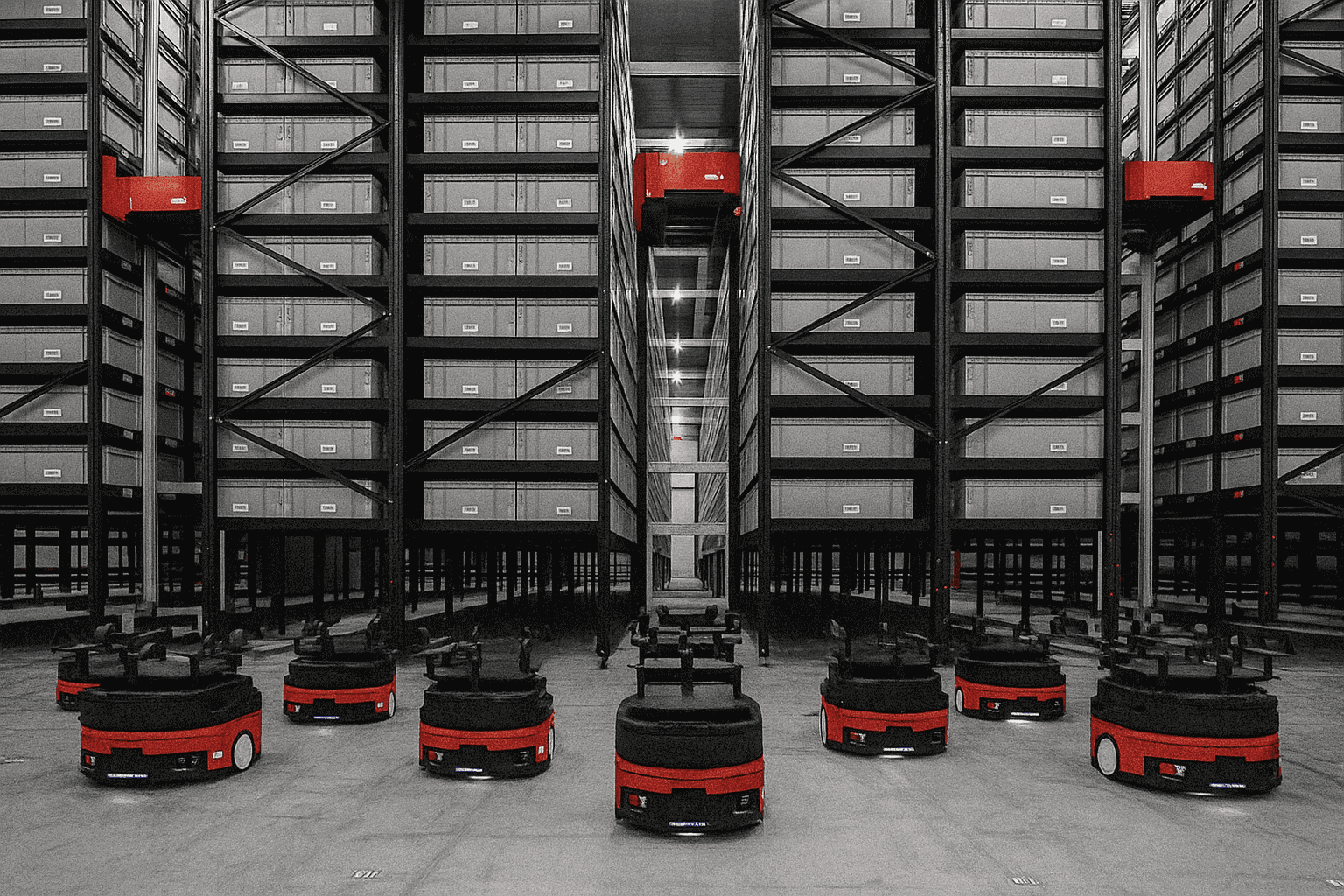
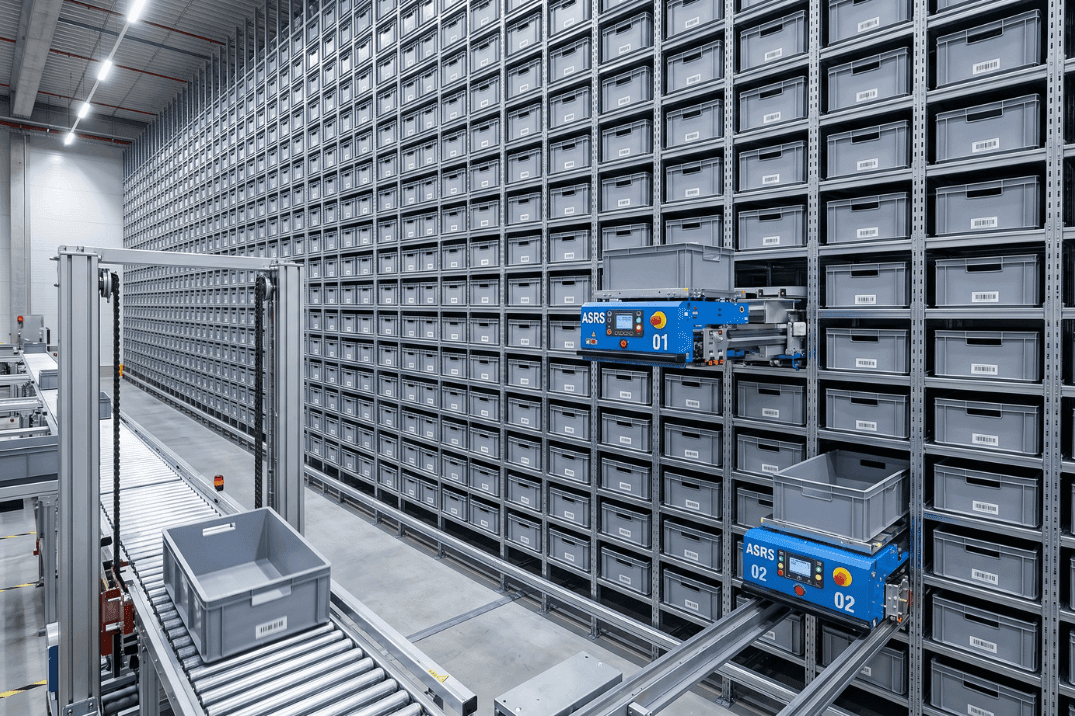
High-density shuttle-based ASRS system with autonomous robots transporting blue storage totes within a structured racking system, illustrating the balance between storage capacity and retrieval responsiveness in automated warehouse operations.

The process typically follows this flow:

Inbound

Inventory enters the system through conveyors linked to receiving, repacking, or decanting stations.

Storage

Equipment such as robots, cranes, shuttles, or carousels moves items to optimal storage locations within high-density racking.

Retrieval

When an order is placed, the system automatically locates and retrieves the required items.

Outbound

Completed orders leave the system through conveyors connected to picking stations, packing areas, or shipping zones.

The entire system is managed by software that connects with the Warehouse Management System (WMS) to keep everything running smoothly and accurately.

Types of AS/RS


There is no one-size-fits-all ASRS solution. Depending on your inventory, throughput requirements, and operational needs, different types of ASRS offer unique advantages.


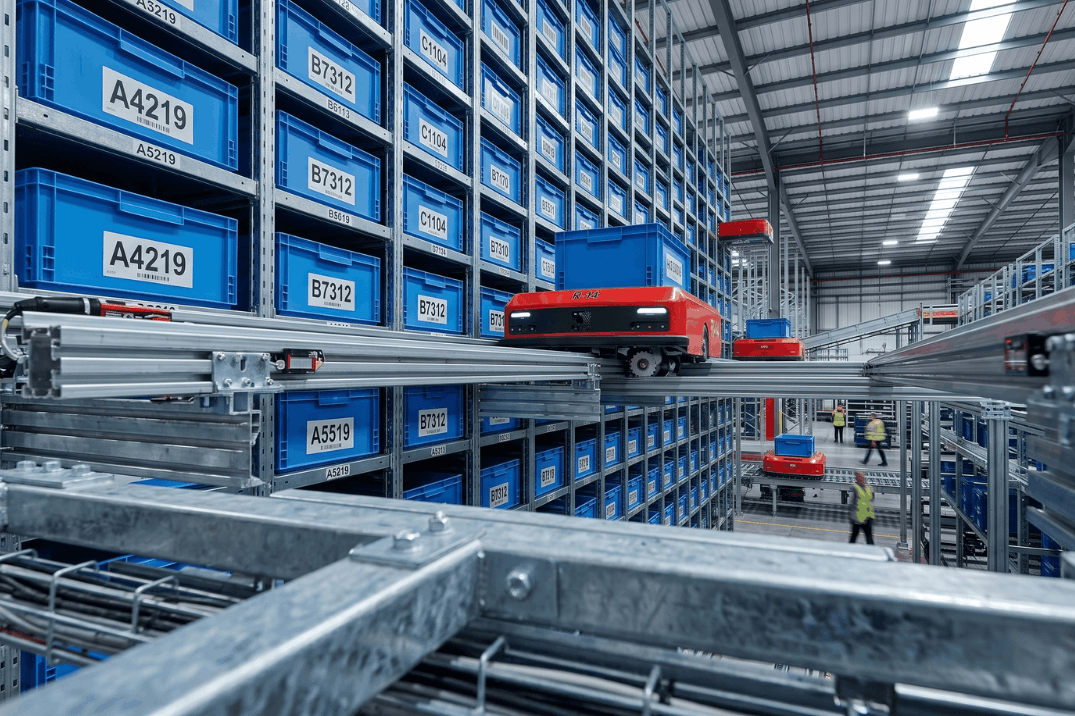
High-speed AS/RS shuttle system moving totes within dense warehouse racking, integrated with conveyor lines transporting parcels for automated sortation and fulfilment


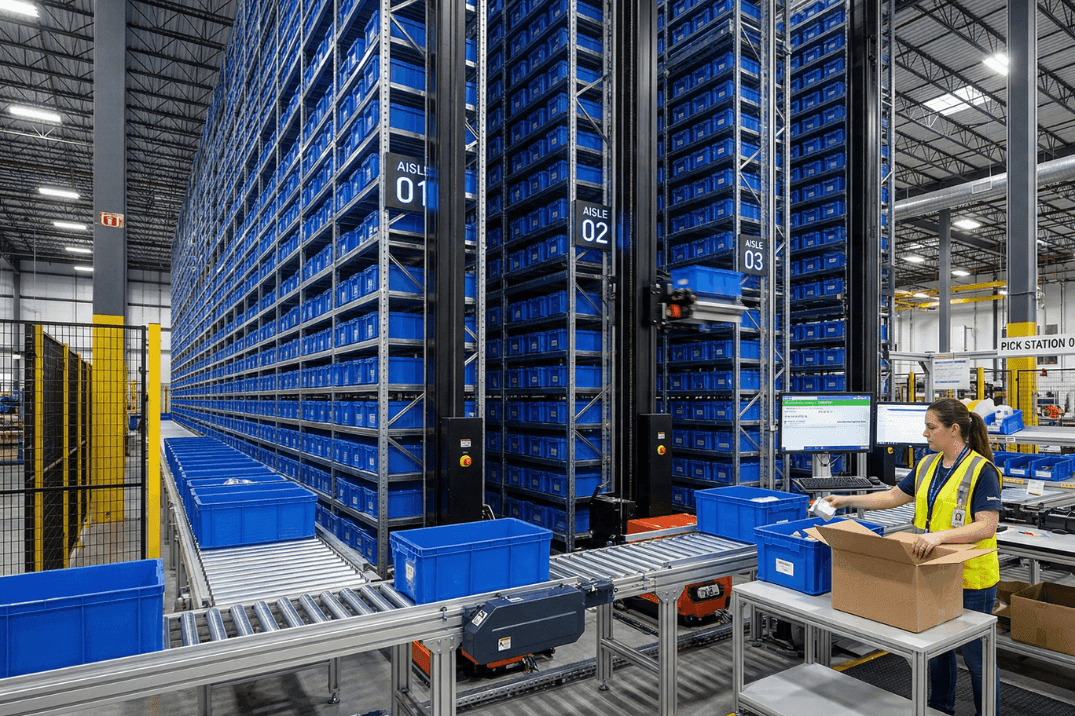
Mini-load automated storage and retrieval system handling totes within dense racking, illustrating a compact ASRS solution suited to retrofit warehouse installations

Unit-load AS/RS

Unit-load systems are designed for large, heavy loads – typically pallets or large containers weighing over 450 kg. They use automated cranes or stacker cranes that run on rails in high-bay racking structures, reaching heights of 18 to 30 metres or more. Best for: High-density pallet storage, bulk handling, and long-term storage of large items.

Mini-load AS/RS

Mini-load systems are similar to unit-load systems but are designed for lighter items stored in totes, bins, or cartons. They use smaller cranes that run in narrow aisles to retrieve items from high-density racking. Best for: Small-item fulfilment, store replenishment, and operations with fast-moving SKUs.

Vertical lift modules (VLMs)

VLMs are enclosed towers with inventory stored vertically on trays on both sides of a central lift mechanism. Items are accessed via an operator window at the base as the lift retrieves the required tray. They dynamically adjust tray positions to maximise vertical space usage. Best for: Storing items of varying sizes, maximising vertical real estate, and applications requiring good security.

Horizontal and vertical carousels

Carousel systems use rotating trays or bins that deliver items to a fixed workstation. Horizontal carousels rotate items around an oval track, while vertical carousels rotate items in a vertical loop. Both are compact and cost-effective for small parts. Best for: Compact, repetitive pick tasks, slow to medium moving SKUs, and MRO parts storage.

Shuttle systems

Shuttle systems use small, fast-moving battery-powered shuttles that run horizontally along rails at each storage level. A vertical lift is typically integrated to move items between levels, allowing access to multiple storage tiers. Shuttles transfer goods to conveyors or lifts, which then deliver them to picking or packing stations. Best for: High-SKU, mixed-velocity e-commerce flows and operations requiring incremental scalability.

Benefits of ASRS


The business case for ASRS is built on measurable, tangible benefits:

Higher storage density

ASRS can achieve 80-90% space utilisation compared to 40-60% for traditional racking. Cube-based systems can offer up to 400% more storage in the same footprint.

Faster throughput

Automated systems deliver consistent cycle times, with goods-to-person shuttle systems capable of delivering 500 to 700 items per hour.

Near-zero picking errors

Integrated with WMS, ASRS achieves accuracy rates significantly higher than manual operations.

Reduced labour costs

Automation tackles labour shortages and reduces reliance on temporary staff.

Improved safety

Reducing manual handling and forklift traffic cuts workplace injuries.

24/7 operation

ASRS does not take breaks, get sick, or need holidays.

Better inventory visibility

Real-time data from the control system gives complete visibility over stock.

ASRS vs traditional racking

ASRS and traditional pallet racking represent two fundamentally different approaches to warehouse storage – one built around human access, the other engineered to eliminate it. Traditional racking leaves 40-60% of warehouse space unused because forklifts require operating clearance and wide aisles. ASRS eliminates these constraints, enabling warehouses to reach heights and densities that are simply impossible with manual systems.

Feature Traditional racking ASRS
Space utilisation 40-60% 80-90%
Aisle width 3-4 metres 1.5-2.5 metres
Maximum height 6-8 metres (forklift-limited) 18-30+ metres
Inventory accuracy 95-98% Near-zero errors
Labour dependency High Minimal
Throughput Linear with headcount Consistent, scalable

Applications and examples


ASRS solutions are deployed across a wide range of industries and applications:

E-commerce and retail

ASRS supports high-throughput, multi-SKU fulfilment operations where speed and accuracy are critical.

Pharmaceutical and life sciences

ASRS can operate in cold storage environments and handle temperature-sensitive products.

Food and beverage

ASRS works in chillers and freezers, with goods-to-person systems keeping operators at comfortable workstations.

Manufacturing

ASRS supports just-in-time production by delivering components to assembly lines precisely when needed.

3PL and distribution

ASRS enables third-party logistics providers to handle multiple clients with diverse inventory profiles efficiently.

MotionTech has delivered ASRS solutions across the UK, including pallet shuttle systems integrated with vertical lifts, conveyors, and warehouse control software – fully tailored to each customer's existing WMS and operational requirements.

Cost and ROI considerations

The cost of an ASRS varies widely depending on the type of system, scale, and complexity.

Starting costs (approximate guide)

System type
Cost (USD)
Cost (GBP)
Vertical Carousel Modules
$70,000+
£56,000+
Vertical Lift Modules
$95,000+
£76,000+
Vertical Buffer Modules
$180,000+
£144,000+
Mini-load ASRS
$750,000+
£600,000+
Unit-load ASRS
$1,000,000+
£800,000+
Multi-Shuttle
$1,000,000+
£800,000+
Robotic Cube Storage
$1,500,000+
£1.2m+

Note: these are starting prices. Fully integrated systems managing large SKU counts can exceed £2.5m+.

ROI and payback

Despite the upfront investment, ASRS delivers substantial returns:

  • 80% of warehouse leaders achieve ROI within the first 12 months.
  • 33% achieve ROI in the first three months.
  • Typical payback periods range from 6 to 18 months for ASRS solutions.

The return comes from multiple sources: labour savings (reduced headcount and temporary staff), space savings (higher density reducing property costs), accuracy improvements (fewer returns and write-offs), and throughput gains (faster order fulfilment).

Several factors influence the final cost: system size (larger systems have lower cost per cubic foot), environment (climate-controlled systems cost more), and stored product characteristics (heavy or oversized items require heavier-duty equipment).

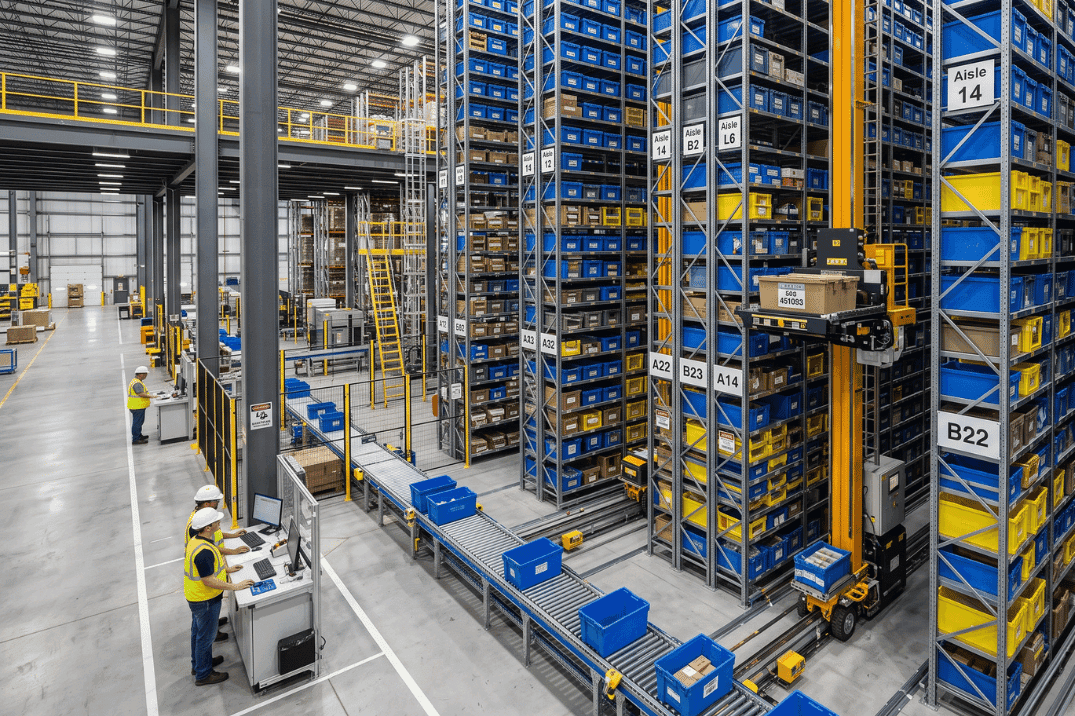
Automated storage and retrieval system with high-density racking, conveyor lines, and operators picking items at goods-to-person workstations in a warehouse environment

Ready to automate your storage?

MotionTech is the UK's end-to-end automation partner. With in-house manufacturing and a full portfolio of conveyors, ASRS, AMRs, and HELIX WCS software, we design, build, and support complete automated storage solutions tailored to your operation.

End-to-end UK automation partner In-house manufacturing Conveyors · ASRS · AMRs · HELIX WCS
Talk to a MotionTech engineer →

Automated Storage and Retrieval Systems FAQS

RELATED ARTICLES