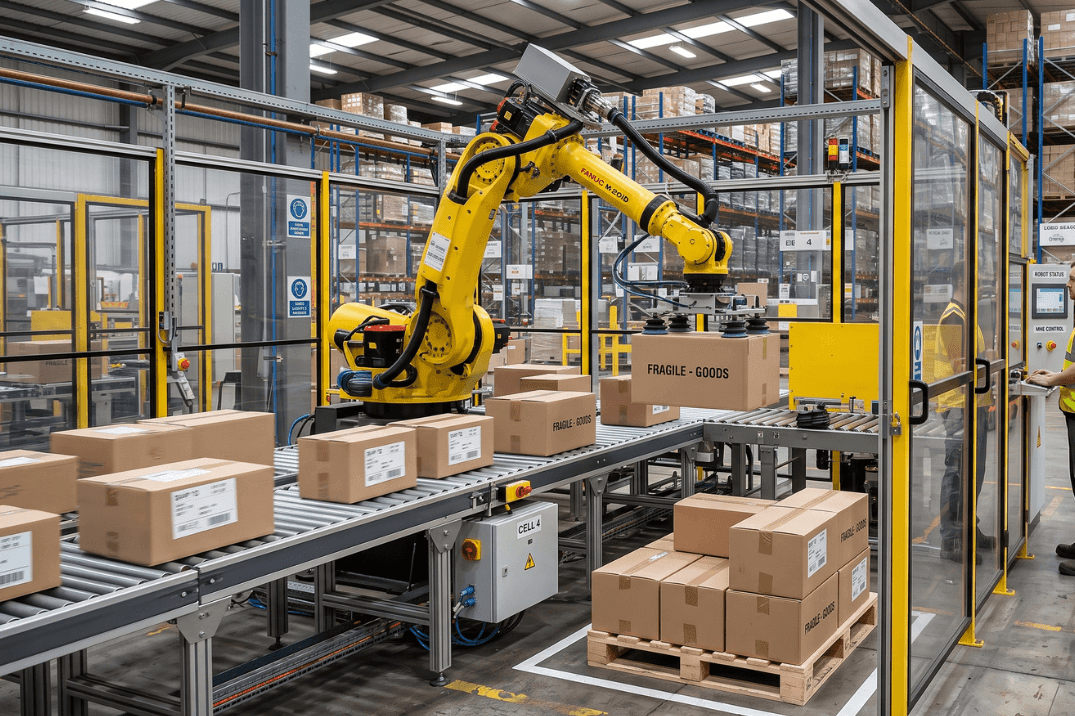
Industrial robotic arm picking and moving boxes from an automated conveyor system in a warehouse

End-of-Arm Tooling: Choosing Grippers for Robotic Handling

Specify a robotic cell and it is tempting to focus on the robot arm, yet the arm itself is rarely what decides whether the cell performs to specification. That role belongs to end-of-arm tooling: the gripper, sensors, and mounting hardware that make physical contact with the product. Robotic handling has become a practical response for UK manufacturers and warehouse operators raising throughput against persistent labour shortages and rising costs, and one of the defining modern manufacturing techniques. Selecting the right robot gripper shapes cycle time, product integrity, and how easily a robotic system copes with change.

Key Takeaways
✓End-of-arm tooling (EOAT) is the gripper and hardware fitted to robotic arms that makes contact with the product.
✓Gripper choice, not the robot, usually decides cycle time, product integrity and flexibility.
✓The main gripping systems are vacuum, parallel-jaw, magnetic, soft/adaptive and bespoke multi-zone handling sets.
✓Every gram of tooling reduces payload and adds cycle time, so lightweight design matters.
✓Tool changers make EOAT a modular system, letting one robot, or a collaborative robot, switch grippers for new SKUs.

What Is End-of-Arm Tooling?

End-of-arm tooling, often shortened to EOAT, refers to any device fitted to the wrist of an industrial robot so that it can interact with a workpiece. In handling applications this is usually a robot gripper, although the assembly may also include vision sensors, force feedback, tool changers, and pneumatic or electrical services.


Tooling is where theoretical robot performance meets the realities of the product: its weight, surface finish, geometry, and tolerance to pressure. A robot rated for a 20 kg payload delivers considerably less once a heavy gripper consumes part of that allowance.

Machine tending robot operating a CNC machine while a skilled operator monitors the automated production cell.

Common Types of Robot Gripper


Gripper selection begins with the physics of the item being handled. The most widely deployed gripping systems in industrial handling include:

Vacuum Grippers

Suction cups lift flat, smooth, or sealed surfaces such as cartons, sacks, and sheet material, making them the default choice for palletising and case handling.

Two and Three-Jaw Parallel Grippers

Mechanical jaws close on rigid components with high repeatability, suiting machine tending, assembly, and precise pick and place.

Magnetic Grippers

Electromagnets or permanent magnets handle ferrous parts quickly with minimal tooling complexity, though they are unsuitable for stainless or non-ferrous materials.

Soft and Adaptive Grippers

Compliant fingers or inflatable elements conform to irregular and delicate items, and are used widely in fresh produce, bakery, and mixed-SKU picking.

Bespoke Multi-Zone Tools

Combination heads, or handling sets, pick several units or full layers at once, often mixing vacuum zones with clamps or forks to manage trays and slip sheets.

Each format carries trade-offs in speed, footprint, weight, and tolerance to product variation.

How to Match End-of-Arm Tooling to Your Product

Product characterisation is the most valuable groundwork before any gripper is specified. Weight distribution, packaging porosity, film wrinkles on a sack, or a laminated carton surface all influence whether vacuum will hold at speed. Delicate goods introduce a further constraint: grip force must be sufficient to secure the item without marking or crushing it. Testing across the full SKU range, including seasonal and promotional packaging, prevents tooling that succeeds in a trial but struggles in production.

Speed, Payload, and Duty Cycle

Throughput targets shape tooling as strongly as the product does. Every additional gram of gripper mass reduces available payload and increases the inertia the robot must accelerate and decelerate, which lengthens cycle time. Lightweight aluminium and composite constructions are increasingly specified for this reason, and are especially important on a collaborative robot, where payloads are lower to begin with. Duty cycle matters equally: seals, cups, and jaw pads are consumable items, and tooling designed for quick replacement keeps maintenance straightforward and downtime minimal.

End-of-Arm Tooling Applications Across UK Industry


The breadth of robot gripper technology allows robotic handling to be applied from end-of-line packaging through to intralogistics. Typical sector applications include:

Food and Beverage

Hygienic vacuum and soft grippers handle trays, pouches, and unsupported packaging where wash-down capability and product care are essential, a core focus of our food and beverage automation.

Logistics and E-Commerce

Adaptive tooling combined with vision supports mixed-case depalletising and single-item pick and place across constantly changing SKU profiles in logistics and e-commerce.

Manufacturing and Automotive

Parallel and magnetic grippers move castings, pressings, and machined components between presses, machine tools, and assembly stations in manufacturing.

Pharmaceutical and Medical

Precise, low-force tooling manages small vials, cartons, and blister packs where traceability and repeatability are tightly controlled, as in healthcare handling.

These varied applications demonstrate how far tooling design determines the flexibility of a robotic cell.

Integrating End-of-Arm Tooling with the Robotic System

End-of-arm tooling is one of the most important automation components, but it does not operate in isolation. Vacuum generation, valve response times, air supply quality, and gripper control all sit alongside the robot controller, safety system, and upstream conveyor or infeed. Where product ranges are broad, automatic tool changers turn the tooling into a modular system, letting one set of robotic arms switch between several grippers within a cycle to support future SKUs. Seamless integration with conveyors, vision systems, and warehouse management software turns an individual robotic system into part of a coherent, connected operation.

Industrial robotic arm integrated alongside an existing conveyor system to automate material handling in a manufacturing facility.

Choosing End-of-Arm Tooling for Long-Term Value

As robotic handling extends further into UK manufacturing and distribution, tooling design will continue to separate cells that meet their rated throughput from those that never quite do. Considered end-of-arm tooling delivers not only reliable product handling but also the flexibility to absorb new SKUs and rising volumes without a full system rebuild. Speak with an automation specialist to develop a robot gripper solution matched to both the product and the process.

Specify the right gripper for your line

From vacuum and parallel-jaw to soft and bespoke multi-zone tooling, our engineers match end-of-arm tooling to your product, throughput and duty cycle.

Speak to a specialist

End-of-Arm Tooling FAQs