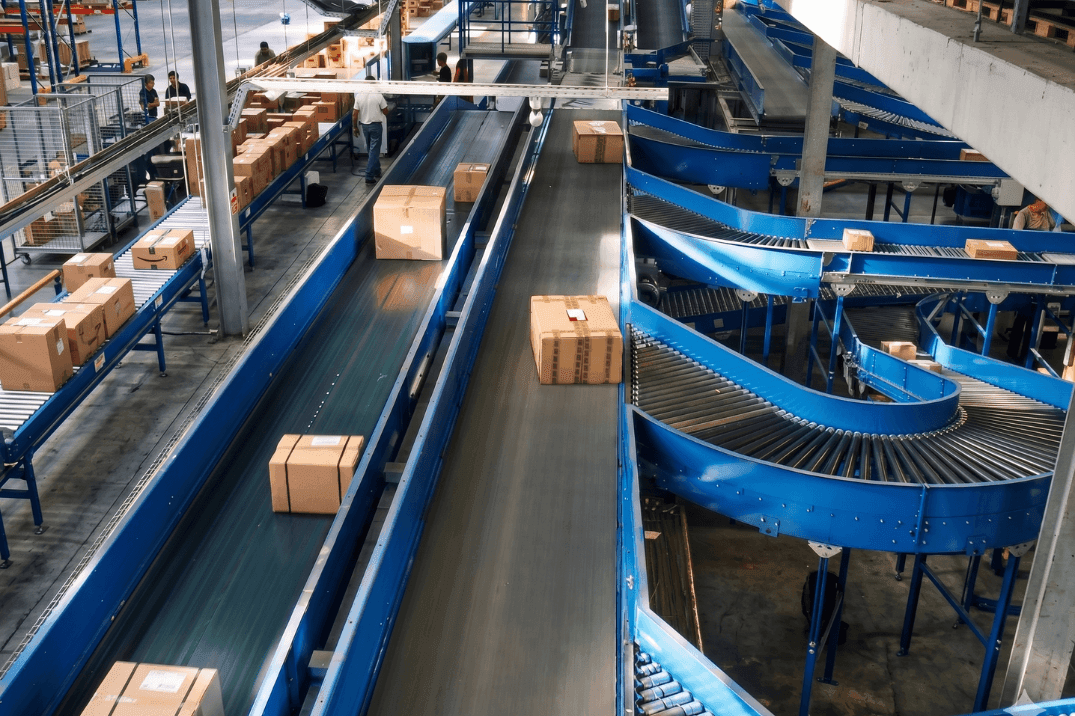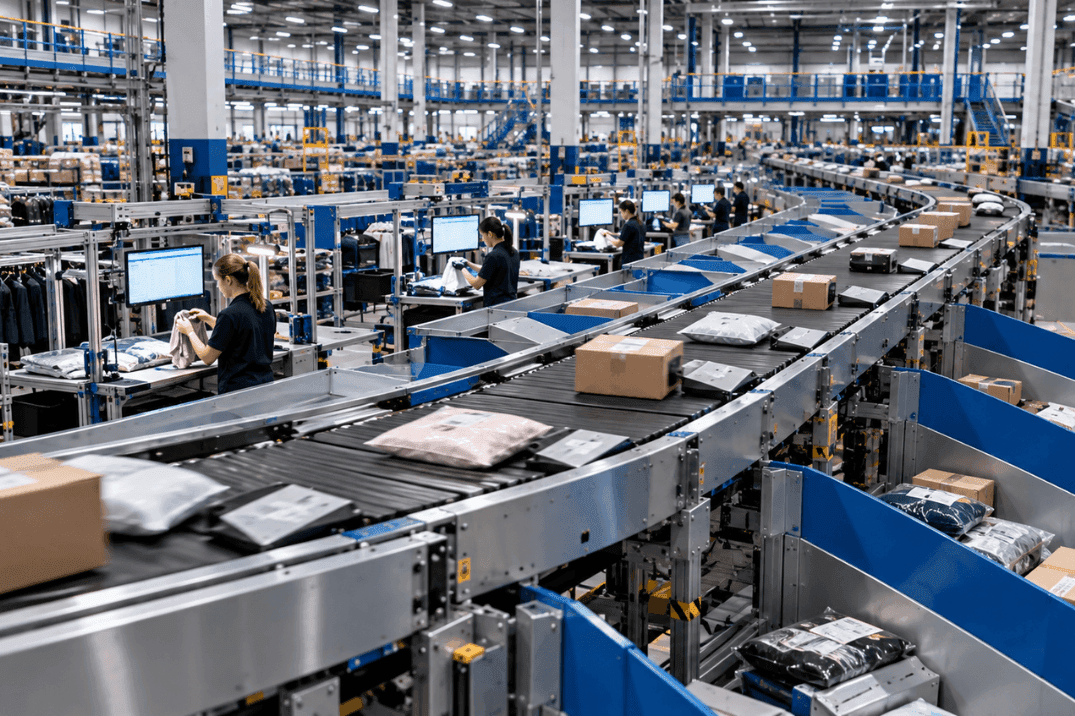
Automated conveyor sortation system processing returned apparel, parcels and polybags in an e-commerce fulfilment centre.

Merge & Divert Conveyors: Controlling Product Flow

Controlling how goods travel between processes has become as important as the processes themselves. UK warehouse and manufacturing operations face mounting pressure to move more product, in more variations, through the same footprint.

The merge divert conveyor sits at the centre of that challenge, combining several product streams into one and separating a single stream into many, all without manual handling.

Key Takeaways

✓

One device, two jobs: a merge divert conveyor combines several product streams into one and splits one stream into many, without manual handling.

✓

Merge vs divert: merging consolidates infeed lines; diverting steers items to pick, pack or despatch destinations.

✓

Tracking makes it work: accurate product tracking (sensors, encoders, scanning) plus consistent gapping.

✓

A range of equipment: from pop-up wheels and pushers to sliding-shoe sorting conveyors and right-angle transfers.

✓

Software-driven flow: zone control and conveyor speed differentials manage flow, all driven by the warehouse control system.

What Is a Merge Divert Conveyor?

A merge divert conveyor is a section of conveyor engineered to bring separate product flows together, or to split a single flow into distinct routes. Merging consolidates cartons, totes, or packages arriving from multiple infeed lines onto one line. Diverting does the reverse, steering individual items off the main line towards a specific destination: a pick station, a packing bench, or a despatch lane. In short, merging and diverting systems are what turn a set of separate lines into one coordinated flow.


Both functions depend on accurate product tracking. Photoelectric sensors, encoders, and barcode or RFID scanning tell the control system exactly where every item sits along the line, and the merge or divert device acts on that data within a fraction of a second.

Sliding-shoe sorter progressively guiding parcels from the main conveyor onto a side lane.

Types of Merge and Divert Conveyor Equipment


Selection depends on product characteristics, required throughput, and the accuracy demanded by downstream processes. The most widely deployed diverting systems and combiners include:

Pop-up wheel diverters

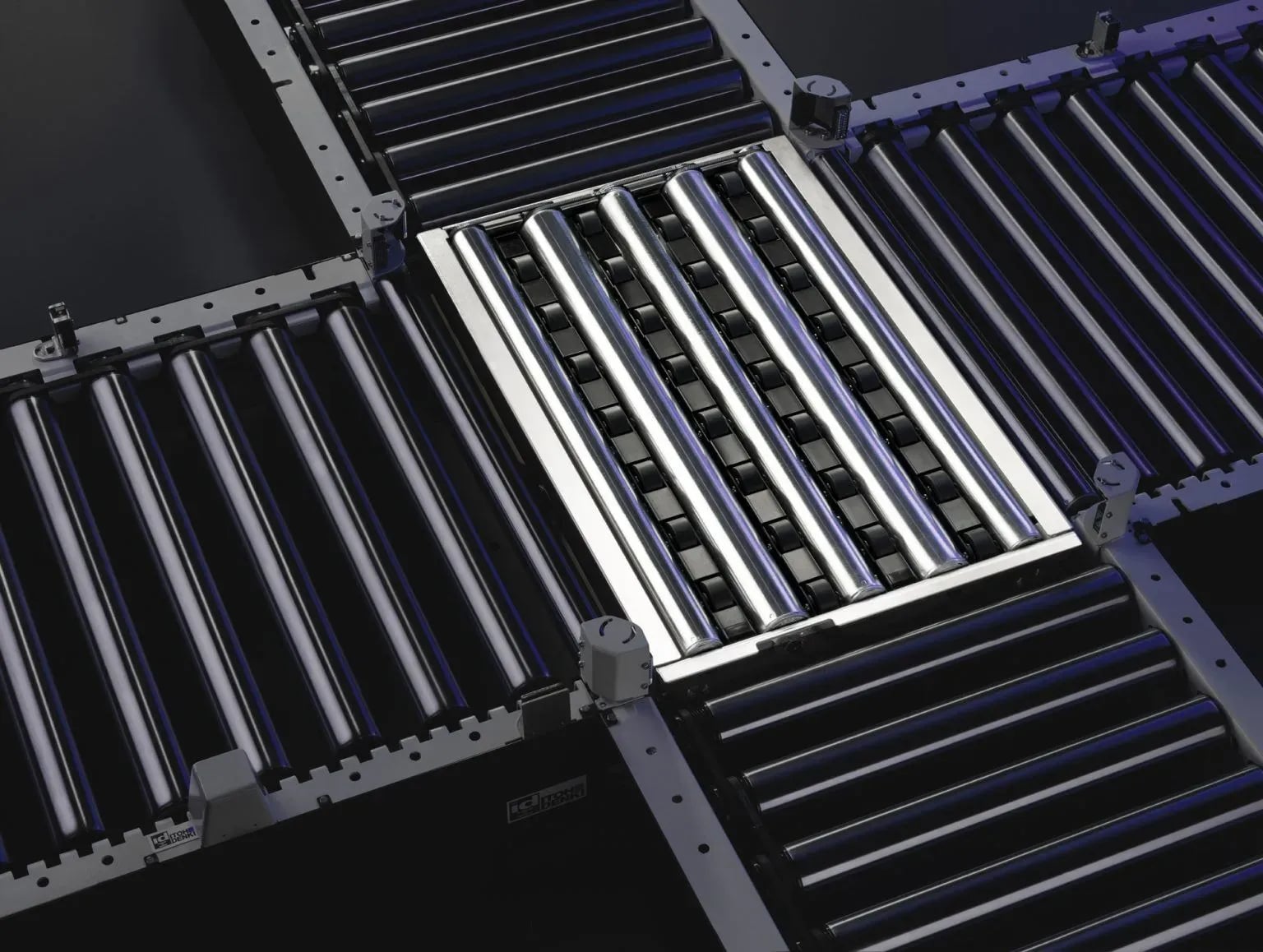
Powered wheels rise between roller gaps to redirect product at 30 or 45 degrees, suited to cartons and totes at moderate rates.

Sliding-shoe sorters

Shoes travel across the conveyor surface to guide items gently sideways. As high-accuracy sorting conveyors, they handle high throughput and mixed product sizes.

Pusher and paddle diverters

A pneumatic or electric arm pushes product across to a take-away lane, offering a low-cost option for robust, uniform loads.

Right-angle transfers

Chain or belt sections lift through the roller bed to move product 90 degrees, commonly used for pallets and heavier unit loads.

Belt and roller combiners

Angled infeed lines meet a main line at controlled speeds, gapping and interleaving product to build a single ordered stream, the core of most merge conveyor systems.

By the numbers

30–45°

pop-up wheel divert angle

90°

right-angle transfer

24V

motor-driven roller zones

<1 sec

divert response to tracking data

How Do Merge Divert Conveyors Control Product Flow?

Effective flow control is as much a software problem as a mechanical one. Zone control divides the conveyor into discrete accumulation sections, each with its own motor and sensor, so product can be released, held, or gapped independently. Consistent gapping is critical: without it, a divert mechanism cannot act on one carton without disturbing the next.


At the merge point, the control system arbitrates between competing infeed lines, prioritising by line, product type, or order urgency. Differences in conveyor speed between the infeed and main line create gaps and prevent collisions. Where 24V motor-driven roller technology is deployed, individual zones run only when product is present, reducing energy consumption and noise across long runs.

Merge & Divert Conveyor Applications Across UK Industry


Merge and divert conveyor arrangements appear wherever a single material flow serves multiple processes or destinations:

E-commerce and retail fulfilment

High order volumes and small basket sizes require product to be sorted to pack stations, then merged again for consolidation and despatch, often on a warehouse belt conveyor spine running the length of the building.

Food and beverage

Production lines divert product between fillers, cartoners, and end-of-line palletising, with washdown construction and hygiene standards shaping equipment choice.

Third-party logistics

Shared facilities handle multiple clients on common infrastructure, using diverts to separate client inventory and merges to maximise use of shared sortation.

Pharmaceutical and healthcare

Batch integrity and traceability requirements mean every divert decision must be recorded against the item and the order.

Manufacturing and assembly

Components are diverted to parallel workstations to balance cycle times, then merged back onto the main line for final assembly and inspection.

Integrating Merge & Divert Conveyors with Wider Systems

Merge divert conveyors rarely operate in isolation. They form the material flow backbone connecting inbound, storage, pick, pack, sort, and outbound processes, and they communicate constantly with the systems either side of them. A warehouse control system coordinates divert decisions with instructions from the warehouse management system, so routing reflects live order data rather than fixed rules.


Robotic palletising cells, print-and-apply labellers, automated storage and retrieval systems, and autonomous mobile robots all rely on product arriving in the right sequence at the right point. Getting the merge and divert logic right is what makes the rest of that automation viable.

High-speed conveyor sortation system with multiple divert lanes, illustrating how upstream changes can impact downstream routing and accuracy

Designing Smarter Product Flow With Merge Divert Conveyors

As order profiles continue to fragment and throughput expectations rise, the ability to route product intelligently will separate operations that scale from those that bottleneck. A well-specified merge divert conveyor delivers not only higher throughput but also better accuracy, less manual handling, and a clearer route to expanding capacity in stages.


Speak with a specialist to design flow control around the products and order profiles the operation actually handles.

Design flow control around your operation

We engineer merge and divert conveyors around your products and order profiles.

Speak to a specialist

Merge & Divert Conveyor FAQs