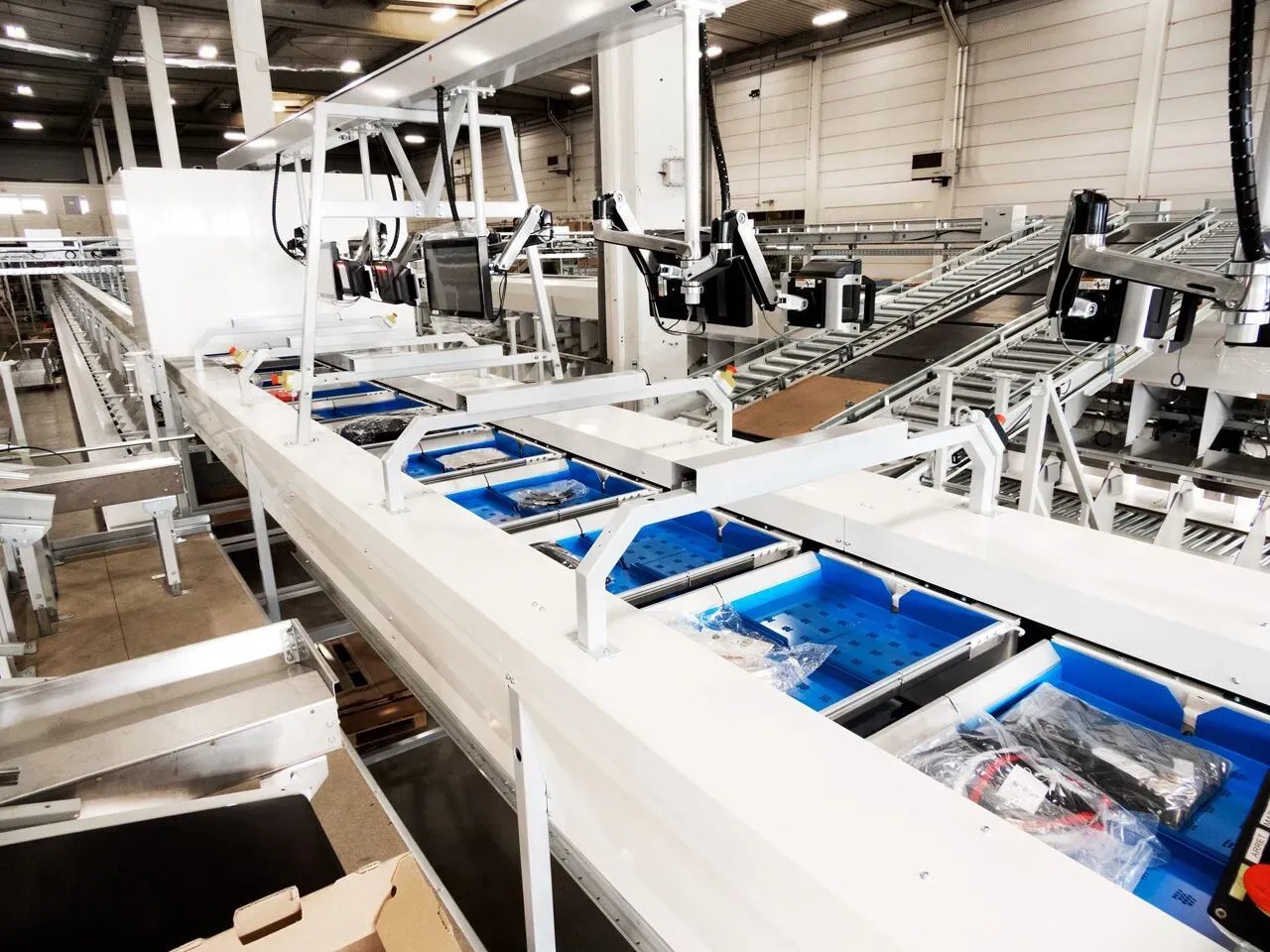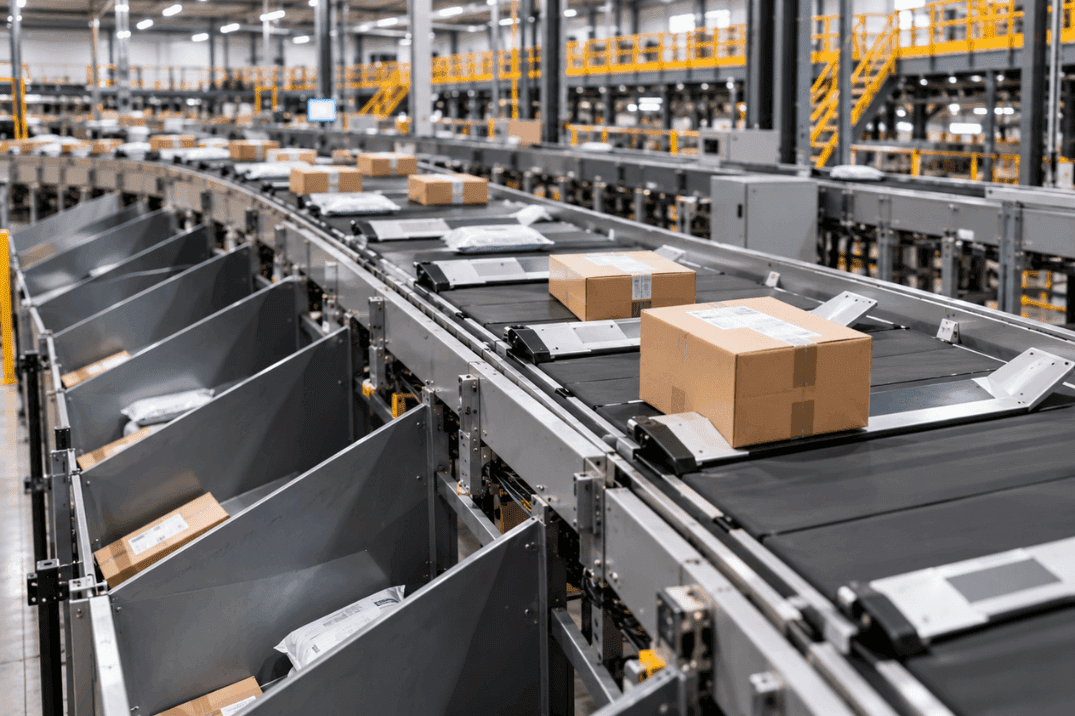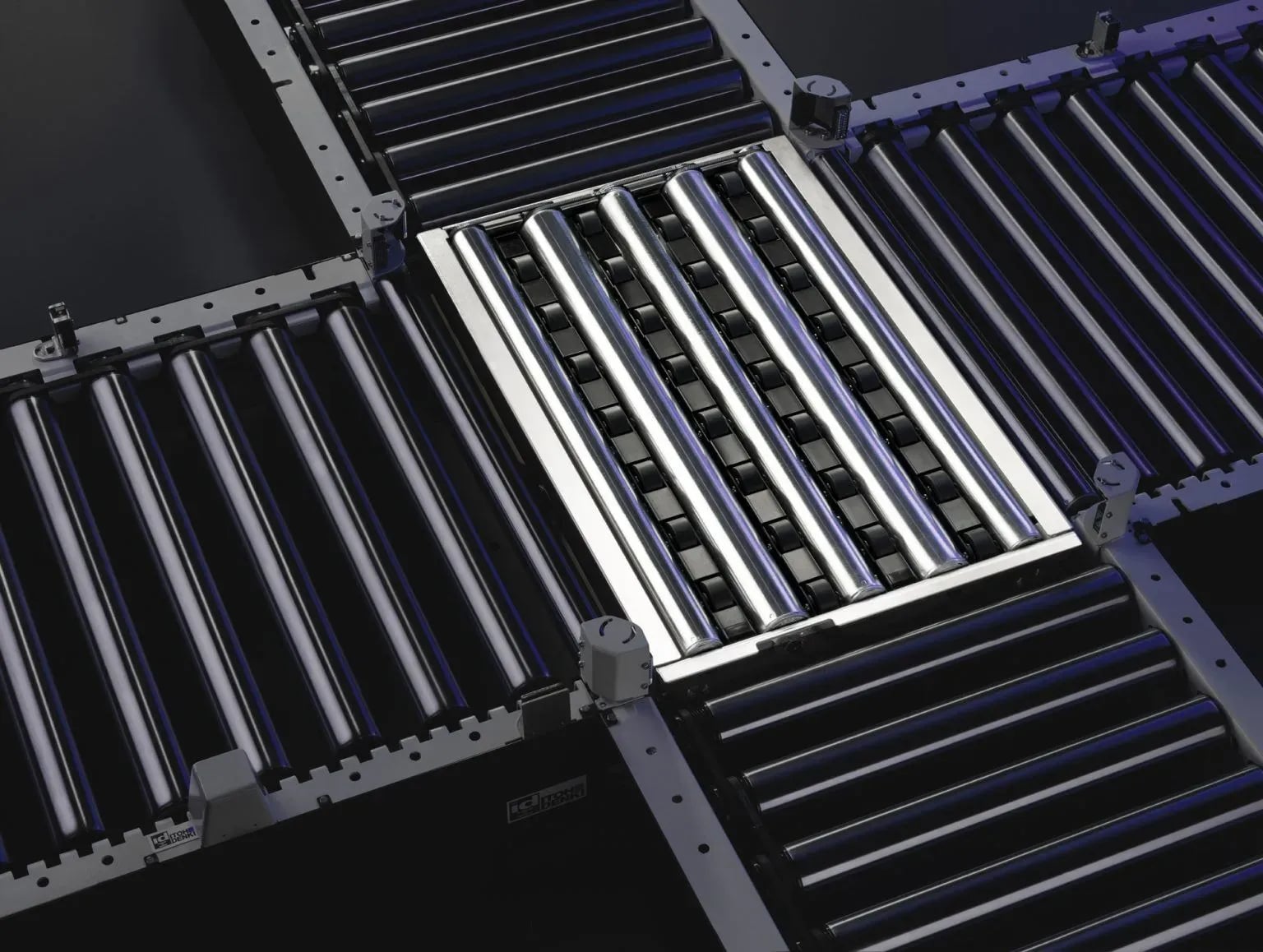
FRAT (Fixed Right Angle Transfer)

Right-Angle Transfers & Pop-Up Conveyors Explained

Warehouse and production operations are being asked to move more product through the same four walls, and floor space is expensive while real layouts are rarely as straight as the material-flow diagram suggests. This is where a right-angle transfer conveyor becomes valuable: a compact device that changes the direction of a load by 90 degrees without a curve, a turntable, or manual intervention. Pop-up conveyors are the most common way of achieving it, and they sit inside thousands of conveyor systems doing work that would otherwise consume far more floor area.

Key points

✓A right-angle transfer conveyor moves a load 90 degrees without a curve, turntable or manual handling.
✓It keeps the load’s orientation, unlike a curve, which matters when downstream equipment expects a specific face.
✓Pop-up chain, roller or belt elements lift 20 to 50 mm to take the load and move it off at right angles.
✓The big win is footprint: the turn happens in roughly the space the load already occupies.
✓Reliable running depends on load geometry, throughput planning and the control system sequencing each transfer.

What Is a Right-Angle Transfer Conveyor?

A right-angle transfer conveyor receives a load travelling in one direction and discharges it at 90 degrees to that path. Unlike a curve, it does not rotate the load. The product keeps its orientation and leaves the line on a different axis, which matters when downstream equipment expects a specific pallet or carton face.


The transfer is created by two conveying surfaces occupying the same footprint at different heights. One carries the load along the main line. The second, mounted beneath it, lifts through to take the load and move it off at right angles. That compact arrangement is what makes a right-angle transfer conveyor system so space-efficient compared with a curve or turntable.

Twin Chain transfer on Pallet Conveyor

How Do Pop-Up Conveyors Create the Transfer?


Pop-up conveyors are the lifting element in that arrangement. A pneumatic cylinder, electro-mechanical actuator or cam mechanism raises the secondary surface by roughly 20 to 50 mm, enough to break contact with the primary surface and take the load. Lift and lower cycles typically complete in under two seconds. Several configurations are used, selected according to load type and throughput:

Pop-Up Chain Transfer

Strands of chain rise between the rollers of a chain-driven live roller conveyor. The standard choice for pallet handling, where the chain engages the pallet bottom boards directly.

Pop-Up Roller Transfer

Short roller sections lift between the strands of a chain conveyor, used where the load needs support across its full width.

Pop-Up Belt Transfer

Narrow belt strands rise through a roller bed to move cartons, totes and polybags. Belts grip lightweight or unstable products more securely than rollers.

Pusher and Paddle Transfer

A powered arm sweeps the load sideways onto a driven surface. Lower in cost, though harder on the product.

By the numbers
90°
Direction change, no curve or turntable
20-50mm
Pop-up lift to take the load
<2 sec
Typical lift and lower cycle
1 footprint
Turn within the load’s own space

Right-Angle Transfer Conveyor Applications Across UK Industry


These devices appear wherever material flow changes axis in a confined space. From end-of-line packing halls to pallet handling in chilled distribution, the applications are broad:

End-of-Line Palletising

Moving pallets from an infeed spur into a palletising cell, then out to a stretch wrapper sitting on a perpendicular line.

AS/RS and Aisle Feeds

Routing loads off a main spine conveyor into individual racking aisles served by an AS/RS, or onto transfer cars serving several aisles.

Sortation Spurs

Diverting cartons from a transport line into pick, pack or despatch lanes for sortation without a dedicated curve on every branch.

Vertical Transfer Interfaces

Presenting loads to vertical reciprocating conveyors and mezzanine lifts, where product enters and exits on different axes.

The common benefit is footprint: the direction change happens within roughly the space the load already occupies, rather than the two to three metres a curve would consume.

Design Considerations for a Reliable Right-Angle Transfer

Running a right-angle transfer conveyor reliably at rate depends on a few decisions taken early. Load geometry comes first: pallets must be transferred in the direction that presents bottom boards to the chain, and any overhang or damaged timber changes how the load behaves during the lift.


Throughput is the second constraint. Each transfer adds a stop, a lift, a cross-travel move and a lower to the cycle, so busy conveyor lines may need paired transfer stations or a continuous alternative such as a turntable. Load stability, centre of gravity and actuator duty cycle all deserve attention at design stage, not at commissioning.

Twin transfer with rollers 2

Integrating a Right-Angle Transfer into the Wider System

A transfer device is only as good as the control logic driving it. Photocells confirm the load is square and fully within the transfer window before the lift is permitted, while barcode or RFID reads upstream determine its destination. The PLC or warehouse control system then sequences each transfer against the receiving line, holding the load when the downstream lane is occupied.


That control layer allows transfers to work alongside robotic palletisers, autonomous mobile robots and automated storage. Mechanically simple devices become the routing points of a wider conveyor system, which is why maintenance access and sensor alignment matter more than the component count suggests.

Pneumatic Pop-Up Transfer

Compact Direction Changes, Measurable Gains

As UK operations compress more throughput into existing buildings, the right-angle transfer conveyor will remain one of the least visible and most useful tools available to system designers. It delivers not only a saving in floor area but also tighter control over product orientation and routing, supporting scalable layouts and long-term operational efficiency. Speak with a specialist to design a transfer arrangement around your load types and throughput targets.

Design a tailored integration approach

We design integration around your existing lines, control systems, and long-term automation roadmap.

Speak to a specialist

Frequently Asked Questions