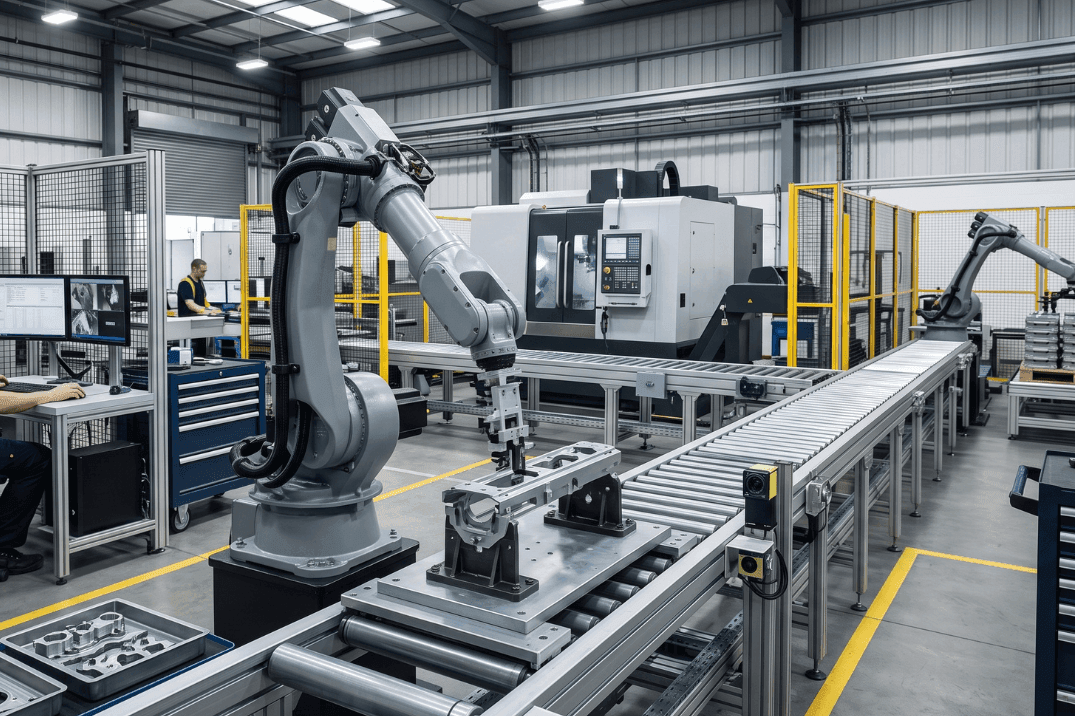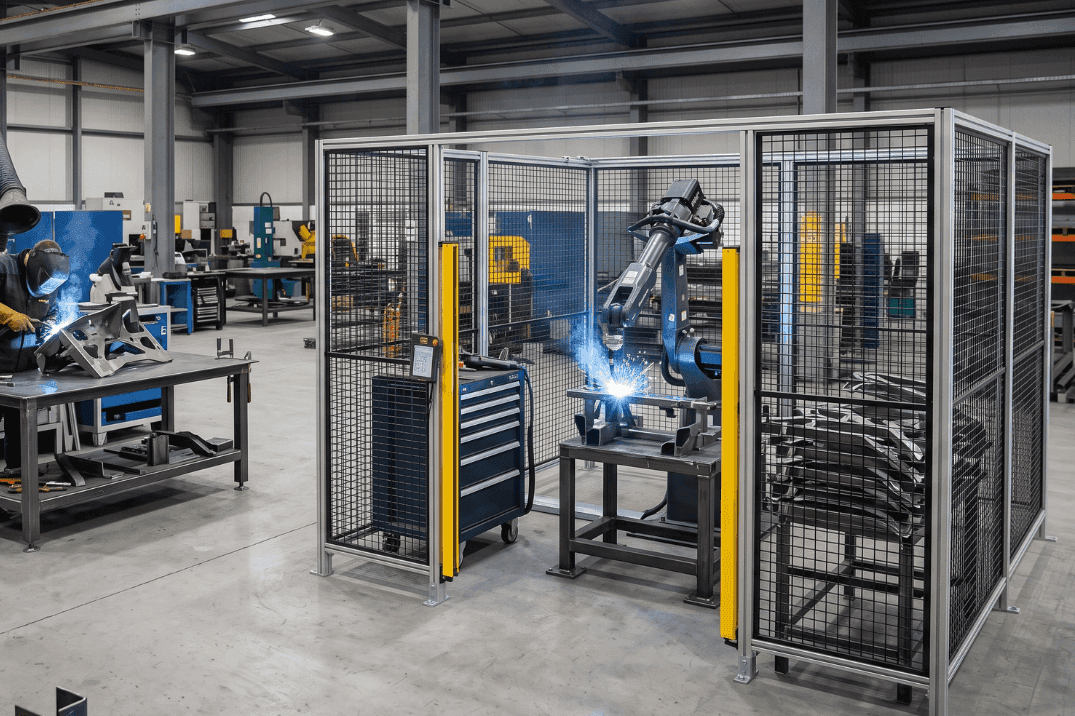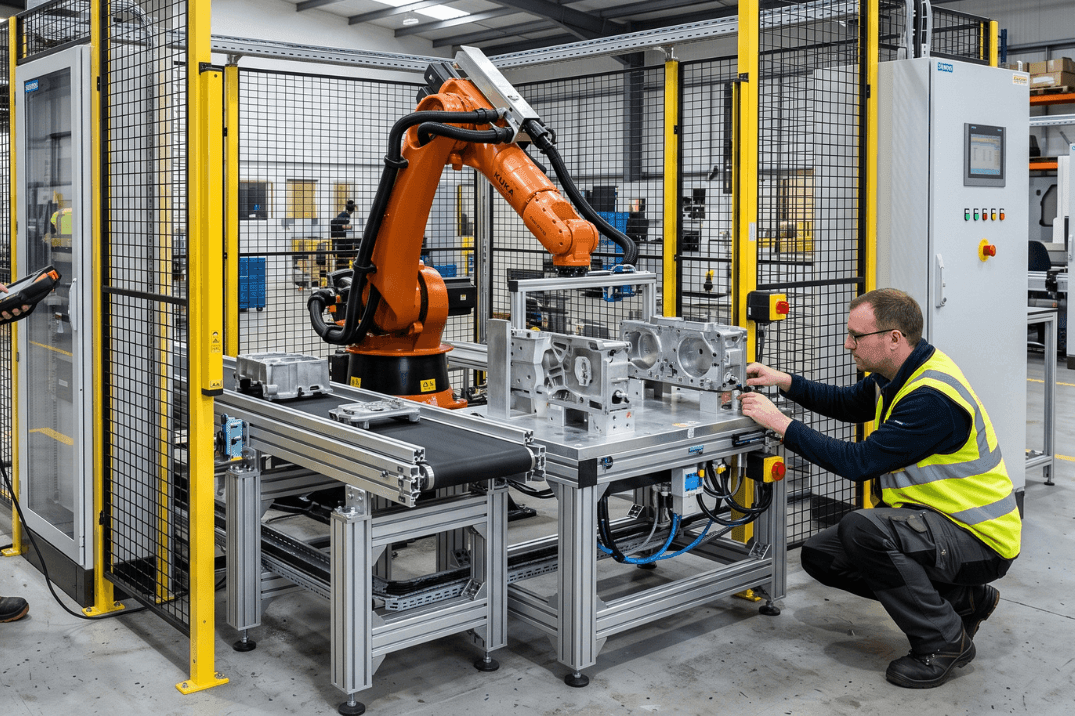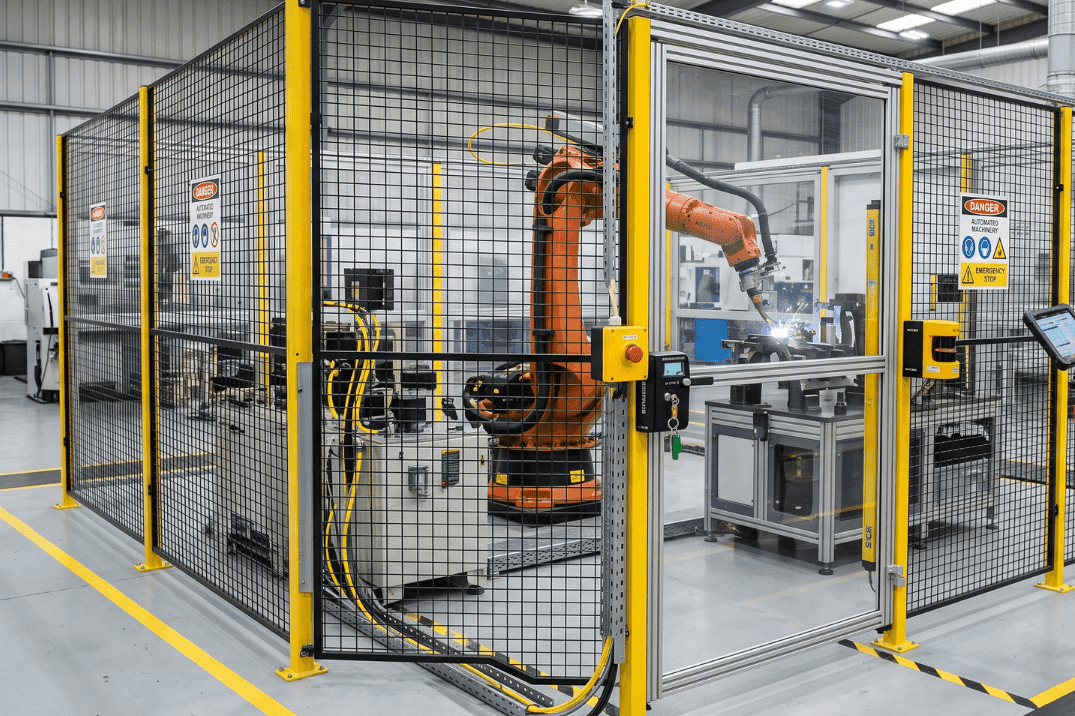
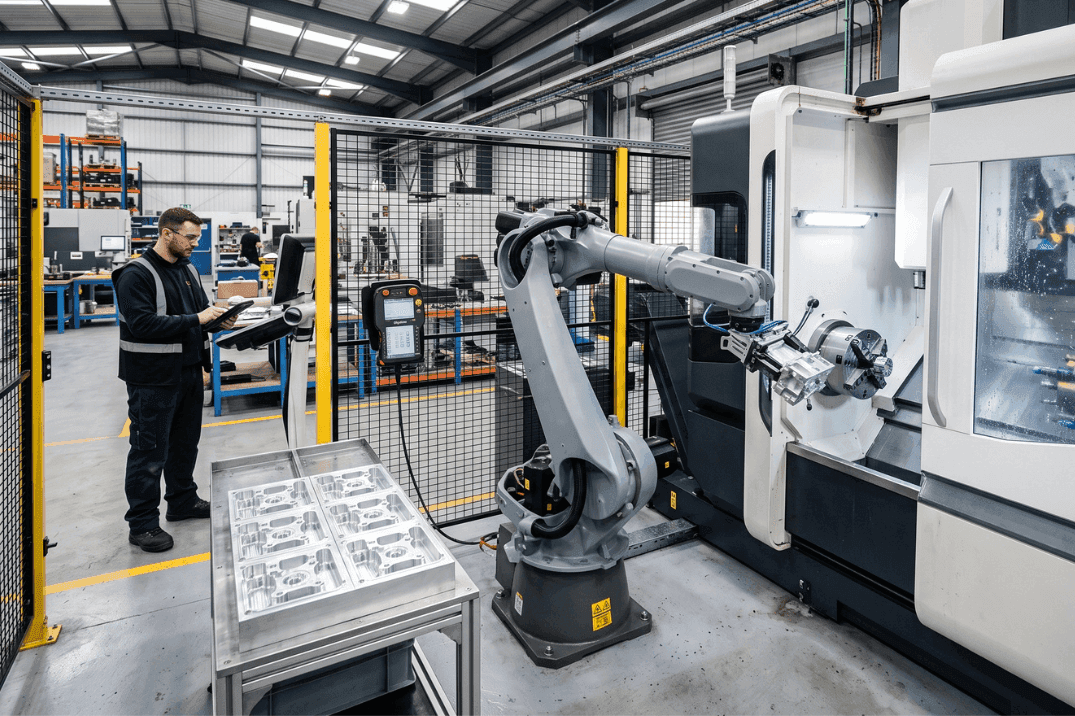
Industrial robot operating inside a guarded safety cell with emergency stops and controlled access in a UK manufacturing facility.

UK Robot Safety Standards

Installing an industrial robot in the UK means meeting PUWER, the Supply of Machinery (Safety) Regulations and the ISO 10218 robot safety standards. This guide explains the key standards, what they require, and how to build a compliant robot cell.

Key Takeaways

  • UK robot installations must meet PUWER 1998 and the Supply of Machinery (Safety) Regulations, with machinery requiring UKCA (or accepted CE) marking.
  • ISO 10218-1 covers the robot itself and ISO 10218-2 covers the integrated robot system and cell.
  • ISO/TS 15066 provides the additional safety guidance for collaborative (cobot) applications.
  • A documented risk assessment is the legal foundation of every compliant robot cell.
  • Compliance is achieved through safeguarding, safety-rated controls, validation and operator training.

Robot Safety Standards in the UK: What Applies?

In the UK, an industrial robot is work equipment and machinery, so it falls under the Provision and Use of Work Equipment Regulations 1998 (PUWER) and the Supply of Machinery (Safety) Regulations 2008. Together these require that the robot cell is safe to use, properly safeguarded, and carries the correct conformity marking (UKCA, with CE still accepted during the transition).

On top of the law sit the harmonised standards that show how to comply in practice, chiefly the ISO 10218 series for industrial robots. Meeting these standards is the clearest route to demonstrating a safe, compliant installation of industrial robotics.

Key Robot Safety Standards and Regulations


PUWER 1998

The Provision and Use of Work Equipment Regulations - the core duty to provide safe, suitable, well-maintained work equipment.

Supply of Machinery (Safety) Regulations 2008

UK machinery law requiring essential health and safety requirements to be met and machinery to be conformity-marked.

ISO 10218-1

Safety requirements for the industrial robot itself (the arm and controller).

ISO 10218-2

Safety requirements for the integrated robot system, cell and installation.

ISO/TS 15066

Supplementary safety guidance for collaborative robot operation, including force and pressure limits.

UKCA / CE marking

The conformity marking that must be applied to machinery placed on the market in Great Britain.

Collaborative Robots and ISO/TS 15066

Collaborative robots that share a workspace with people carry their own considerations. ISO/TS 15066 supplements ISO 10218 with guidance for collaborative operation, including the force and pressure limits that keep any contact with an operator below the threshold of injury.

A cobot is not automatically safe just because it is collaborative; the application still needs a risk assessment. Our guide to collaborative robots in manufacturing explains where cobots fit and how they are deployed safely.

PUWER
1998 - core duty on safe work equipment
ISO 10218
Parts 1 & 2: robot and robot system
ISO/TS 15066
Collaborative robot safety
UKCA
Marking required for machinery

Building a Compliant Robot Cell: Start with Risk Assessment

Every compliant robot cell starts with a documented risk assessment. This identifies the hazards (crushing, trapping, impact, tooling and process risks), assesses the level of risk, and defines the safeguards needed to reduce it, whether fixed guarding, light curtains, safety scanners, or the speed and separation monitoring used with cobots.

The assessment drives everything that follows: the guarding design, the safety-rated control system, the validation, and the documentation that supports the conformity marking. Skipping or rushing it is the most common cause of non-compliance.

Steps to a Safe, Compliant Robot Installation


Risk assessment

Identify hazards and required risk reduction before any design is fixed.

Safeguarding design

Specify guarding, light curtains, scanners or speed-and-separation monitoring to suit the risk.

Safety-rated controls

Use safety-rated components and architecture to the required performance level.

Validation and testing

Prove the safety functions perform as intended before handover.

Documentation and marking

Compile the technical file and apply the correct UKCA/CE conformity marking.

Training and safe systems of work

Train operators and maintainers and put safe working procedures in place.

Safe Robot Integration with MotionTech

MotionTech designs and integrates robot cells to meet UK requirements, from risk assessment and safeguarding design through to safety-rated controls, validation and the documentation you need for sign-off. We build safety in from the concept stage rather than bolting it on at the end.

Our robot integration specialists handle compliance as part of every project. Contact us to discuss a safe, standards-compliant installation.


This guide is general information, not legal advice. Always confirm your specific duties with a competent person and current HSE guidance.

Ready to automate a process? Our integration specialists scope the cell, the tooling and the return around your line.

Speak to a specialist

Frequently Asked Questions