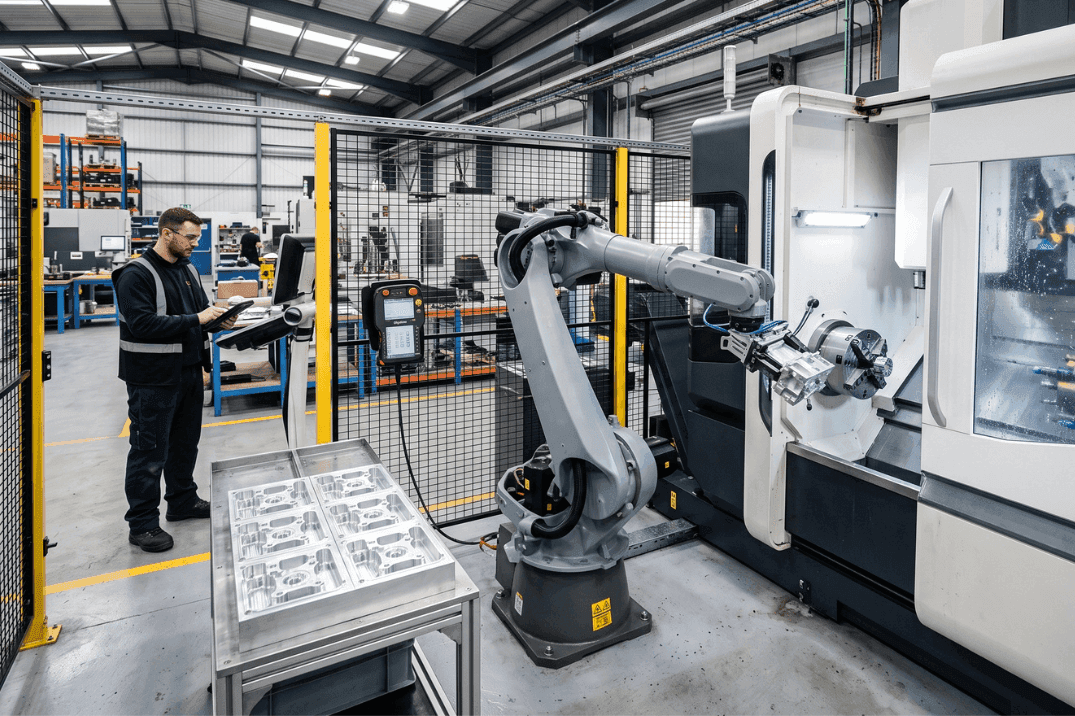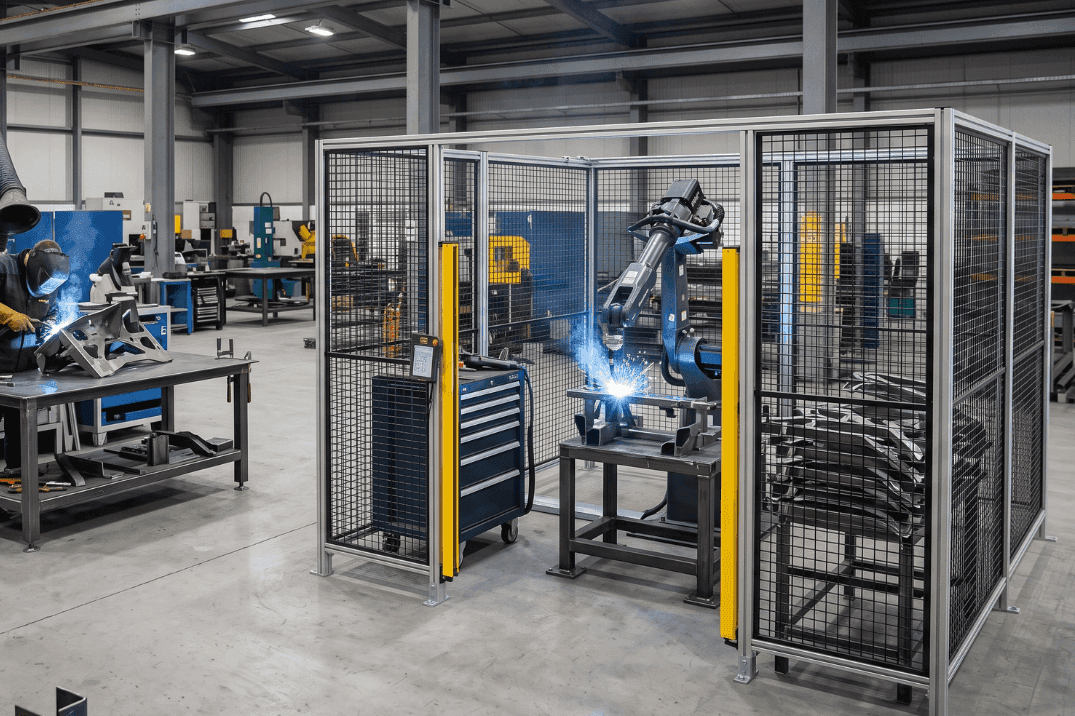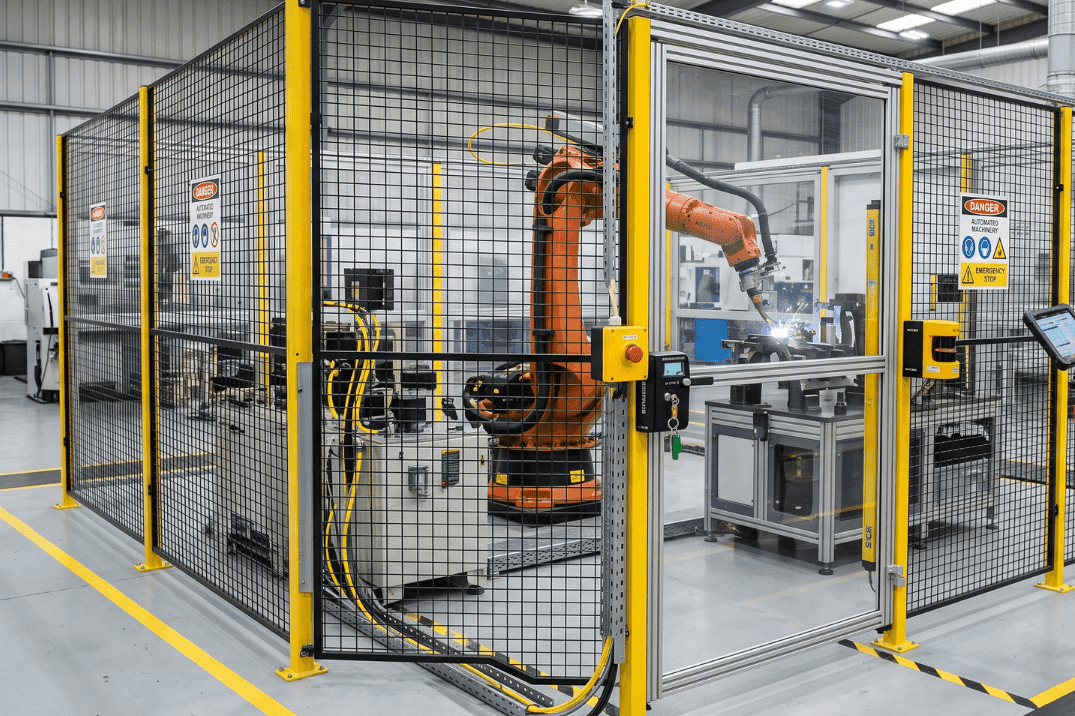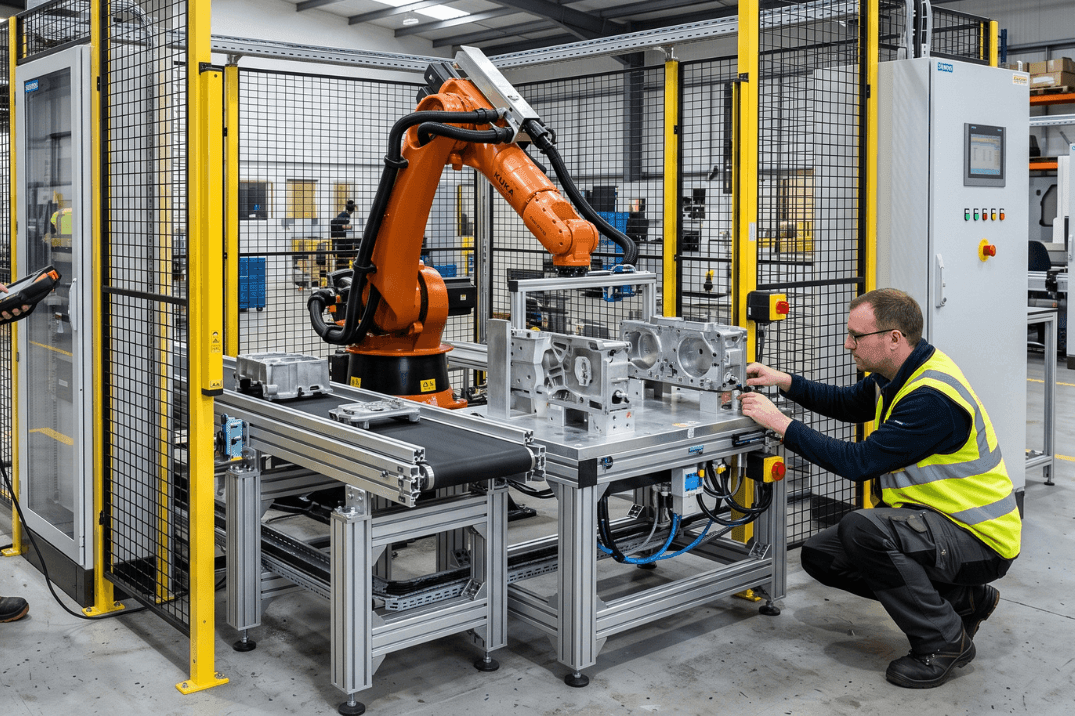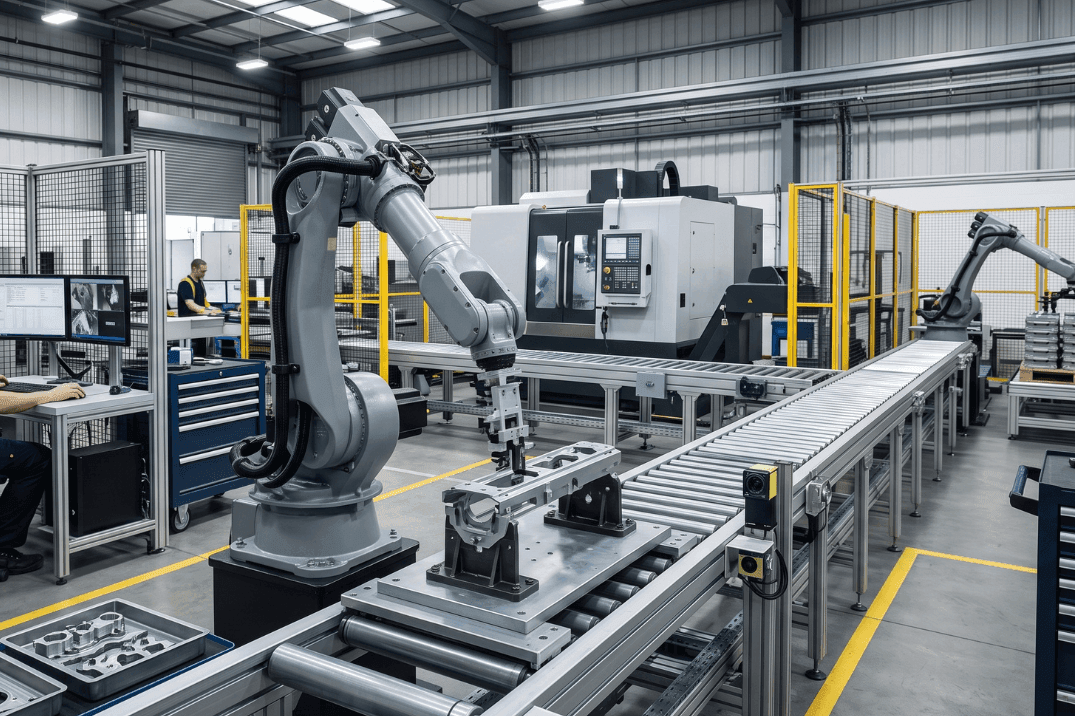
Industrial robot automating the handling and assembly of precision metal components in a manufacturing cell.

Robotics Applications in Manufacturing

From welding and assembly to machine tending, palletising and inspection, robots now touch almost every stage of manufacturing. This guide maps the core robotics applications in manufacturing, how to match a robot to the task, and the returns UK manufacturers can expect.

Key Takeaways

  • Robotics applications in manufacturing span welding, assembly, machine tending, material handling, palletising, dispensing and inspection.
  • The right robot depends on the task: articulated arms, SCARA, delta, cartesian and collaborative robots each suit different jobs.
  • The strongest candidates are repetitive, high-volume, hazardous or ergonomically risky tasks.
  • Most manufacturing robot cells reach payback within two to three years.
  • Starting with one well-chosen application proves the return before scaling across the plant.

What Counts as a Robotics Application in Manufacturing?

A robotics application is any production task handed to a robot instead of a person or a fixed machine, from joining and handling parts to checking quality. Modern manufacturing rarely automates a whole factory at once; it automates specific, well-defined tasks where a robot is faster, safer or more consistent than the manual alternative.

Robotics is now central to competitive manufacturing. For the underlying technology and robot types, see our guide to industrial robotics, and our robotics hub for the full range of solutions MotionTech delivers.

Industrial robots, conveyors and machine vision integrated into an automated manufacturing production line.

Core Robotics Applications in Manufacturing


Welding and joining

Robotic arc, spot and laser welding for repeatable, high-quality joins.

Assembly

Fitting, fastening and screwdriving at speed, often with SCARA or cobot arms.

Machine tending

Loading and unloading CNC, presses and moulding cells to keep machines running.

Material handling and palletising

Moving, sorting and stacking products, including robotic palletising.

Pick and place

High-speed transfer of parts between processes, feeders and packaging.

Dispensing and finishing

Consistent application of adhesive, sealant, paint and coatings.

Inspection and quality

Vision-guided checking and measurement built into the production flow.

Choosing the Right Robot for the Job

No single robot suits every task. Articulated six-axis arms are the workhorses for welding, tending and handling; SCARA and delta robots excel at high-speed assembly and pick and place; cartesian robots suit large, linear moves. Collaborative robots trade speed for the ability to work safely alongside people in tight spaces.

Matching payload, reach, cycle time and precision to the task is what turns a robotics application into a reliable, returning investment rather than an expensive experiment.

4M+
Industrial robots operating worldwide
6
Core application areas across the factory
2-3 yr
Typical manufacturing payback
24/7
Consistent, unattended output

Benefits Across the Factory

Wherever they are applied, manufacturing robots deliver the same core gains: higher and more predictable output, consistent quality, better use of skilled labour, and improved health and safety on dull or dangerous tasks. Because a robot repeats the same motion every cycle, scrap and rework fall and capacity becomes easier to plan.

The financial case is usually strong and quick. Our guide to robotics ROI and payback shows how to model the return before you commit.

Signs a Task Is Ready to Automate


Repetitive and predictable

The same motion runs many times an hour with little variation.

High volume

Throughput is enough to justify the cell and pay it back quickly.

Ergonomic or safety risk

The task involves lifting, hot tools, sharp edges or fumes.

Quality-critical

Consistency matters and manual variation causes scrap or rework.

Hard to staff

The role is difficult to recruit for or suffers high turnover.

Bottlenecking the line

The manual step limits the output of everything downstream.

Applying Robotics with MotionTech

MotionTech helps UK manufacturers identify their best first application, design the cell, and integrate it into existing lines and controls. We are technology-agnostic, so we specify the right robot and tooling for each task rather than forcing a single platform onto every job.

Our robot integration specialists can review your process and recommend where robotics will add the most value. Get in touch to start the conversation.

Ready to automate a process? Our integration specialists scope the cell, the tooling and the return around your line.

Speak to a specialist

Frequently Asked Questions