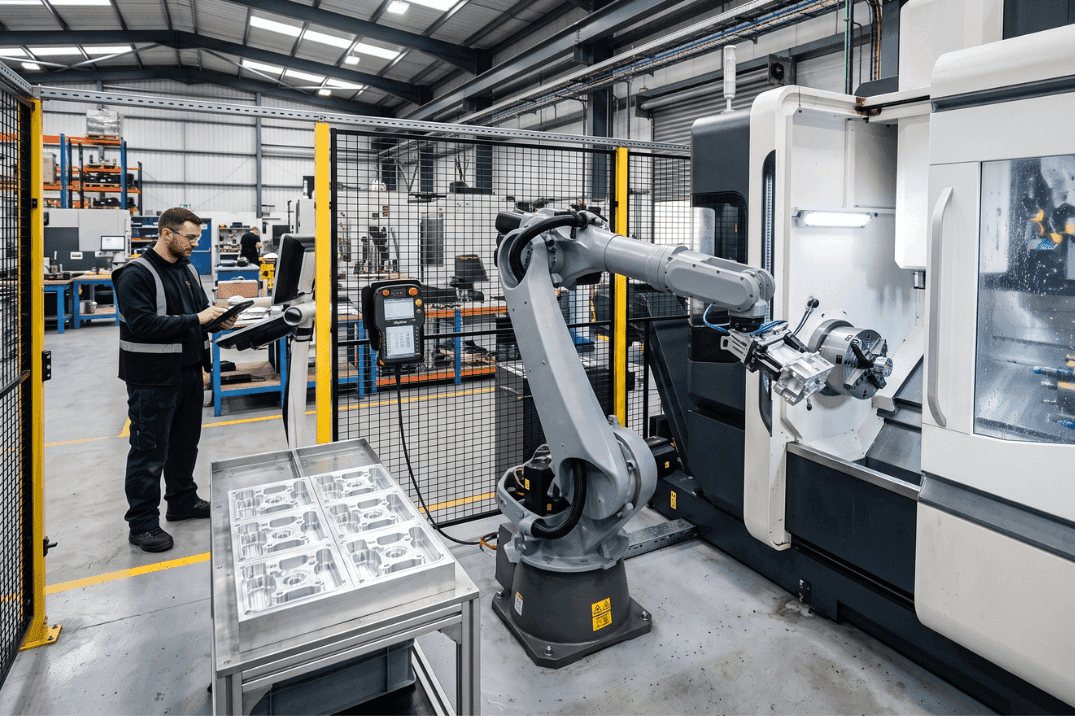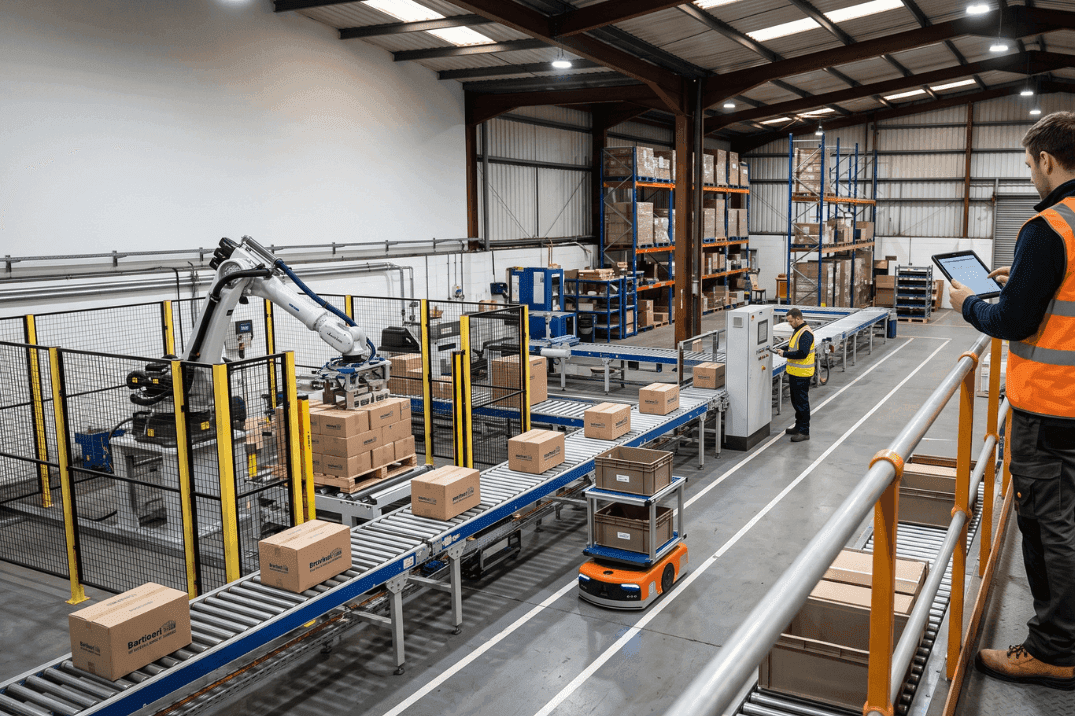
Driverless AGV forklift transporting palletised goods through a modern automated warehouse.

AGV Forklifts: Driverless Pallet Movement Explained

Manual forklift fleets are one of the hardest resources in a warehouse to plan around. Persistent labour shortages, rising wage costs, and tighter margins have left UK operators trying to move more pallets with fewer people to drive them. The AGV forklift is increasingly deployed to close that gap, taking on the repetitive pallet transport tasks that once required a dedicated operator on every shift. Understanding how these vehicles work, and where they deliver the strongest return, is the starting point for any operation weighing up driverless material handling operations.

Key points

✓An AGV forklift is a driverless industrial truck that lifts and moves palletised loads along predefined routes.
✓Also known as an automated guided forklift or robotic forklift, and often searched as autonomous forklifts.
✓Built on counterbalance, reach or pallet-truck chassis fitted with navigation systems, laser sensors and safety scanners.
✓Ideal for repetitive pallet transport over fixed routes in high-volume warehouse operations.
✓The strongest return comes from multi-shift material handling operations running around the clock.

What Is an AGV Forklift?

An automated guided vehicle (AGV) forklift, also called an automated guided forklift or robotic forklift, is a driverless industrial truck that lifts, transports, and deposits palletised loads along predefined routes without an onboard operator. In most cases the base machine is a recognisable counterbalance, reach, or pallet truck chassis fitted with navigation sensors, safety scanners, and a control system that links back to warehouse software. The result is a vehicle that performs the same lifting duties as a manned truck, but repeats them at a consistent cycle time throughout the shift.


Unlike autonomous mobile robots, which plan their own routes dynamically, an AGV forklift follows a fixed or semi-fixed path defined during commissioning. That predictability is an advantage in high-volume operations where the same movements are repeated hundreds of times a day.

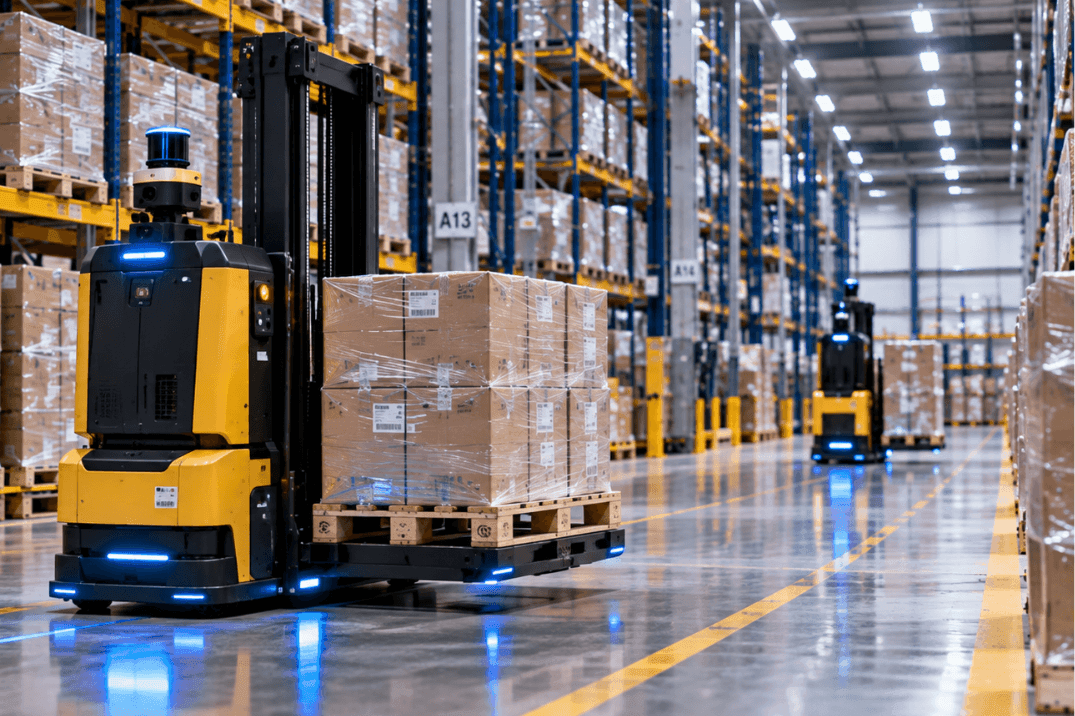
Automated guided vehicle forklift carrying a wrapped pallet between warehouse storage racks.

Types of AGV Forklift in Use Today


The term Automated Guided Vehicles covers a wide range of forklift formats, each suited to a different pallet handling duty:

Automated Counterbalance Trucks

Designed for heavier loads and floor-level pallet handling, the counterbalanced AGV works without outriggers and suits trailer loading, production line feeding, and block stacking.

Automated Reach Trucks

Fitted with a telescopic mast for narrow aisle racking, capable of placing pallets at heights that would otherwise demand a skilled operator working at speed.

Automated Pallet Trucks

Low-lift vehicles built for horizontal transport over longer distances, typically moving loads between goods-in, buffer areas, and despatch lanes.

Automated Tow Tractors

Used where multiple loads travel the same route, pulling trains of trolleys or dollies to consolidate movements into a single trip.

Vehicle selection follows load weight, lift height, aisle width, and throughput requirements rather than preference.

How Do AGV Forklifts Navigate?

Navigation is the defining characteristic of any AGV forklift, and the navigation technology chosen shapes both installation cost and layout flexibility. Older installations rely on inductive wire or magnetic tape set into the floor, which is dependable but requires physical alteration to change a route. Laser guidance, using reflectors and onboard laser sensors, offers greater flexibility and remains widely specified for pallet handling duties.


Natural feature navigation is gaining ground, allowing vehicles to map racking, walls, and columns to locate themselves without added infrastructure. Whichever of these navigation systems is used, safety scanners, bumpers, and load sensors govern how the vehicle behaves around people and obstacles, while a link to the warehouse management system supplies the task list that keeps the fleet working to live demand.

AGV forklift using LiDAR scanning and path planning technology to navigate an automated warehouse.
By the numbers
24/7
Runs across every shift
0
Drivers needed per truck
4
AGV forklift formats
3
Navigation methods

Benefits of AGV Forklifts in Pallet Handling


For warehouse operations running repetitive movements over long distances, the case for automation is straightforward:

Consistent Throughput

Cycle times do not vary by operator, shift, or time of day, which makes capacity planning far more predictable as transport volumes grow.

Enhanced Safety

Removing manual trucks from busy travel routes reduces the risk of pedestrian collisions and racking damage, two of the most common causes of warehouse incidents.

Redeployed Labour

Staff move from driving to higher value tasks such as picking, quality checks, and exception handling.

Lower Operating Costs

Automated charging, controlled acceleration, and gentler load handling reduce energy use, tyre wear, and product damage across the vehicle life.

These gains compound in multi-shift operations, where the same asset works around the clock with minimal downtime.

AGV Forklift Applications Across UK Industry


From food and beverage production to third party logistics, driverless pallet movement suits almost any environment with predictable flows:

Food and Beverage

End of line palletising output moved directly to cold store or despatch across food and beverage sites without manual intervention.

Manufacturing

Raw material delivery into production cells and finished goods removal on a fixed takt time.

Third Party Logistics

Long horizontal runs between inbound docks, storage, and outbound staging, where distance rather than complexity drives cost.

Pharmaceutical

Traceable movements with a full audit trail in pharmaceutical operations, supporting compliance requirements around batch handling.

These diverse applications demonstrate the flexibility of AGV forklift trucks across very different operating models.

How AGV Forklifts Fit Into Warehouse Automation

AGV forklift trucks rarely work in isolation. Fleet software and an interface to the warehouse management system decide what moves and when, while conveyor system hand-offs, palletisers, and automated storage and retrieval systems (ASRS) handle the transfer at each end of the route. Designed together, these automation solutions turn isolated pallet transport into a single, coordinated flow of warehouse automation rather than a set of separate machines.

Is an AGV Forklift Right for Your Warehouse?

As sensor costs fall and navigation software matures, the AGV forklift is shifting from a specialist investment to a practical option for mid-sized UK operations. 


For businesses handling steady pallet volumes across fixed routes, automation delivers not only measurable gains in operational efficiency but also a safer working environment and a stronger platform for long-term growth. Speak with a specialist to assess where driverless handling fits an existing layout.

Driverless AGV forklift moving a pallet along a designated route in a modern distribution centre.

Design a tailored integration approach

We design integration around your existing lines, control systems, and long-term automation roadmap.

Speak to a specialist

Frequently Asked Questions