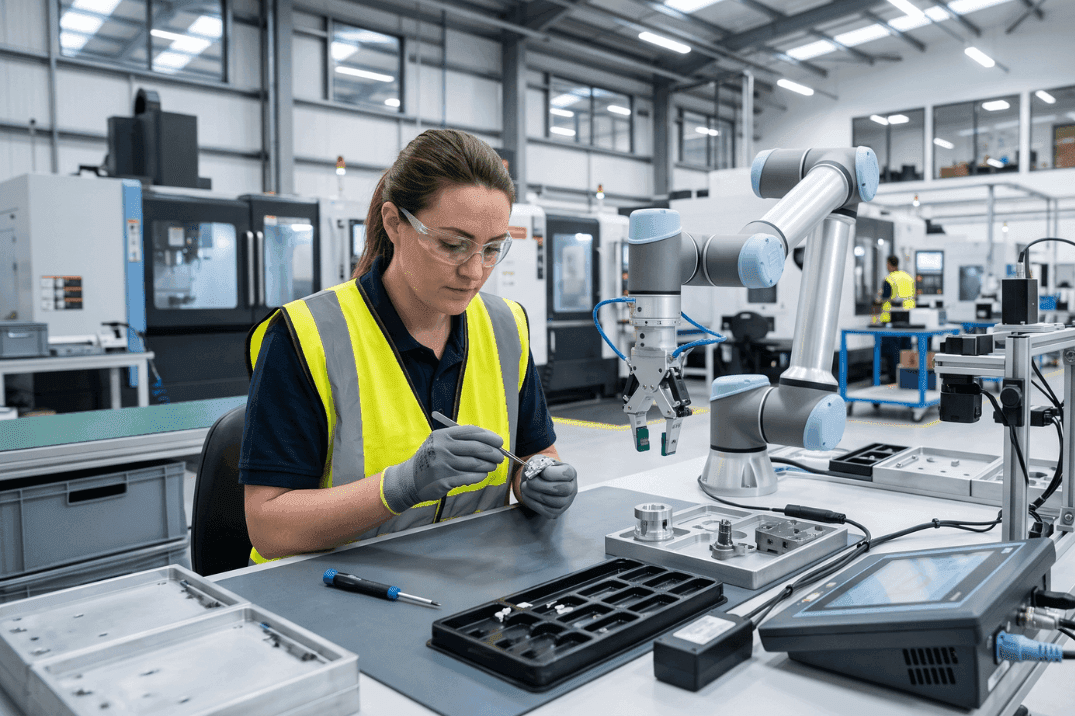
Collaborative robot working alongside a human operator at a manufacturing workstation.

What Are Cobots? Collaborative Robots Explained

What are cobots? Collaborative robots are industrial robots designed to work safely alongside people, using sensors, AI and force limiting to automate repetitive, strenuous or precision tasks in manufacturing and warehousing.

Key Takeaways
  • Cobots (collaborative robots) are industrial robots built to work safely alongside people, without cages, using sensors, AI and force limiting.
  • They are lighter, cheaper and easier to program than traditional industrial robots, ideal for SMEs and flexible, low-to-medium-volume work.
  • Safety is governed by ISO 10218 (2025) and ISO/TS 15066; the latest standards assess safety at the application level, not the robot itself.
  • Common uses span assembly, pick and place, palletising, machine tending, quality inspection and warehouse picking.

What are cobots?

Collaborative robots, often called cobots, are a type of industrial robot specifically designed to work safely alongside human workers in a shared workspace. Unlike traditional robotic systems that require cages, safety barriers, or separation from the human workforce, cobots use advanced sensor technology, artificial intelligence, and control algorithms to detect human presence, adjust their speed, and prevent collisions in real time.

Their purpose is to support people by automating repetitive, strenuous, or precision-based tasks, while maintaining strict safety protocols and meeting international safety standards. Cobots are lightweight, flexible, and easy to program, making them suitable for both large-scale factories and small and medium-sized enterprises (SMEs).

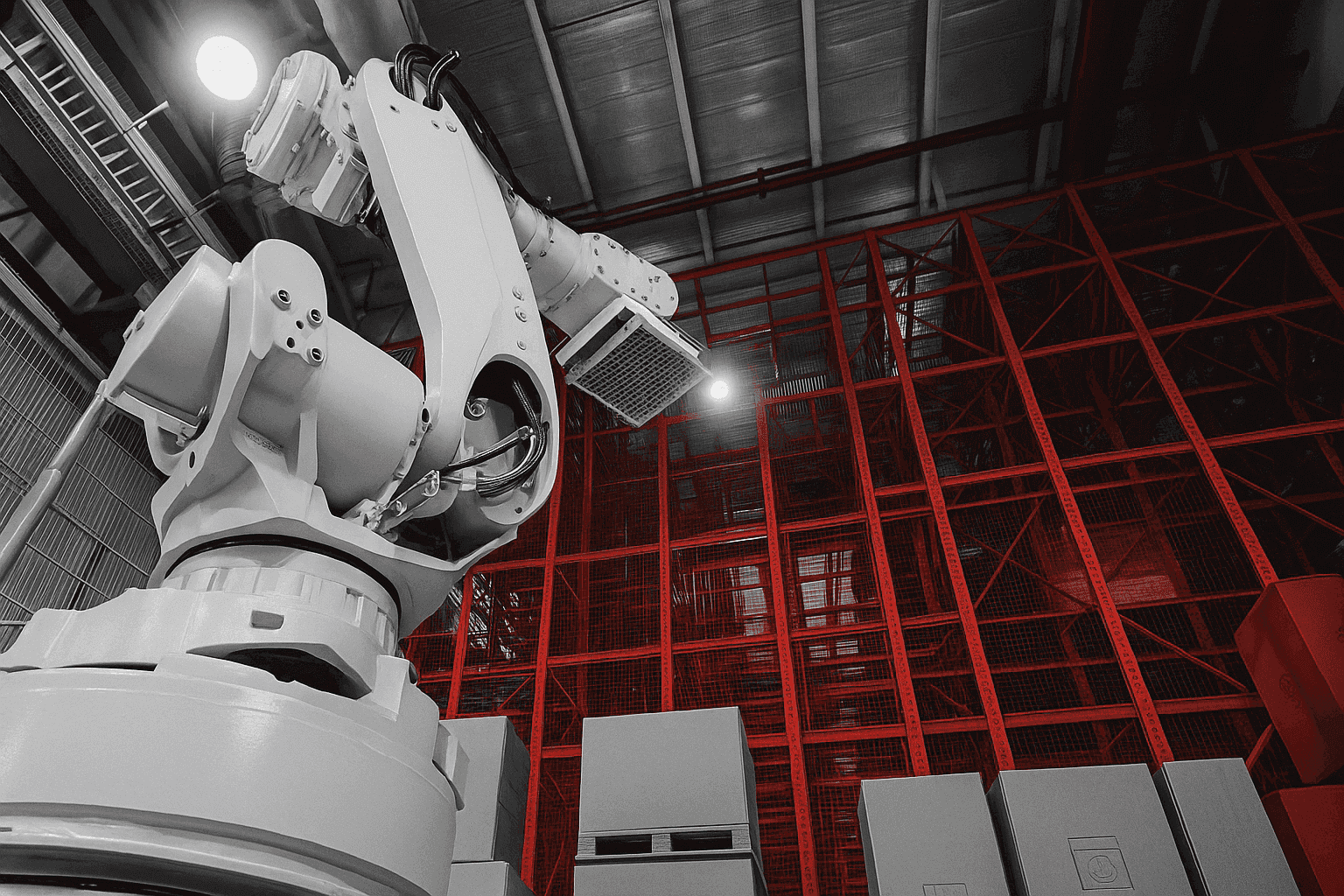
What is collaborative robotics?

Collaborative robotics refers to the field of technology and engineering focused on enabling collaborative interaction between humans and robots. It merges robotics with human-centric design, emphasising shared tasks, mutual responsiveness, and intelligent workflows.

Cobots are a response to the growing demand of manufacturing companies, especially smaller and medium-sized ones, for flexible and safe automation solutions. As part of the shift towards Industry 5.0, cobots combine the efficiency of industrial automation with human creativity, ensuring productivity gains while enhancing workplace safety.

Collaborative robotics is not just about the hardware; it encompasses the entire ecosystem of sensors, control software, machine learning algorithms, and safety systems that enable safe human-robot collaboration.

How do cobots work?

Cobots function through a combination of sensor inputs, control software, and machine learning algorithms. Here is how they operate:

How cobots work


Sensors and perception

Cobots use sophisticated sensors to detect human presence, navigate complex environments and avoid obstacles, including force and torque sensors to detect contact, vision systems and cameras for object recognition, proximity sensors for distance measurement, and speed and position sensors for motion control.

Control algorithms

Advanced control algorithms process sensor data in real time, allowing cobots to adjust their speed, force and trajectory to prevent collisions and ensure safe operation alongside humans.

Machine learning

The integration of AI and machine learning enables cobots to learn from their environment and continually improve their performance over time.

Programming

Cobot programming generally does not require the same sophistication as traditional robots, which can lower the overall price tag. Many cobots feature lead-through teaching and hand-guiding, letting users demonstrate tasks by physically guiding the robot arm.

Safety systems

Built-in features such as force and speed monitoring, collision detection and emergency stop functions ensure cobots can operate safely in close proximity to humans.

Cobots vs traditional industrial robots

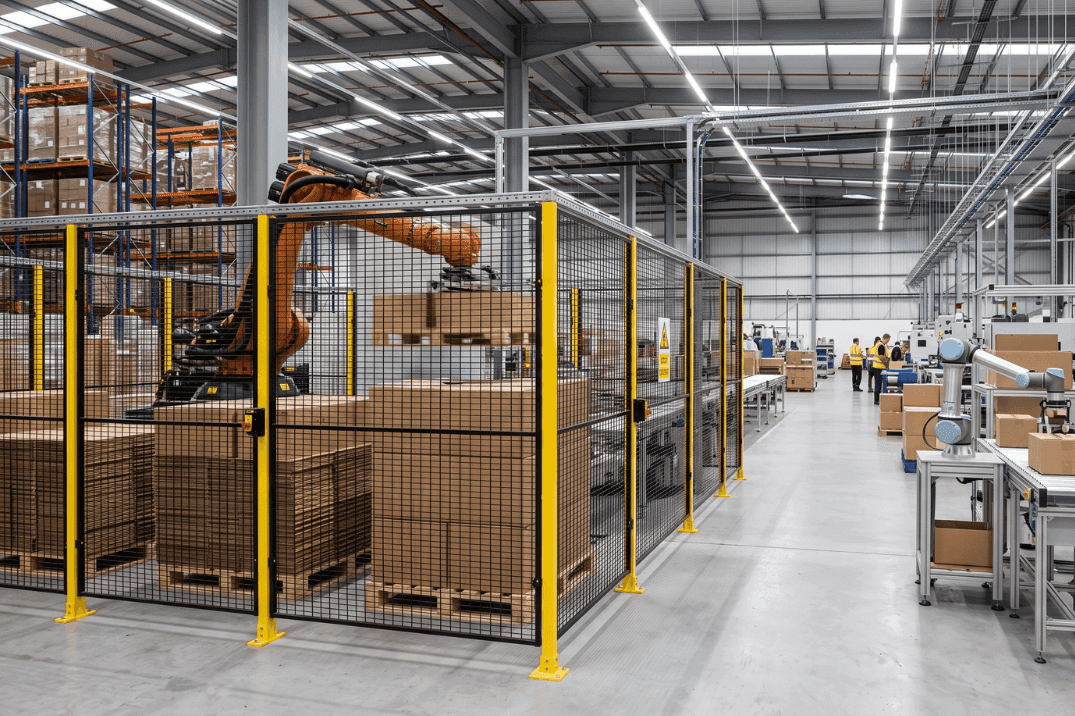
Traditional industrial robots have historically been securely installed in an enclosed environment away from employees, as they pose a variety of hazards and often lack the sensory capabilities necessary to detect nearby humans. These robots, although more expensive, are not prohibitively so and remain favoured by large corporations.

Cobots can be considered the modernised robot, with multiple motions and designed to work collaboratively with the human workforce. They have been favoured by SMEs due to their flexibility and lower costs, helping smaller players within the market.

FeatureTraditional Industrial RobotsCollaborative Robots (Cobots)
WorkspaceRequire cages, safety barriers, or separation from workersWork safely alongside humans without barriers
SafetyLack sensory capabilities to detect nearby humansBuilt-in force and speed monitoring, collision detection
ProgrammingRequire sophisticated programming skillsEasy to program with lead-through teaching
CostHigher upfront investmentLower overall price tag
FlexibilityGenerally fixed in placeLightweight and easily redeployed
Best forHigh-volume, repetitive productionSMEs, low- to medium-volume, flexible production
PayloadUp to 800kg+Typically lighter (varies by model)

Cobot safety standards and features

Cobot safety is governed by international standards that have evolved significantly in recent years.

Key safety standards


ISO 10218 series

The primary international standard covering safety requirements for industrial robots, including cobots. The revised ISO 10218:2025 expands robotics safety to include secure integration into applications and robotic cell environments. The requirements of ISO/TS 15066 are now part of the ISO 10218 series, consolidating collaborative-robot safety into one set of standards.

ISO/TS 15066

A technical specification that specifically addresses collaborative robot safety, defining force and pressure limits for different body regions.

Four collaborative operation modes


Important: the new ISO 10218 standards move away from labelling a machine itself as a "cobot" and instead require safety to be defined at the application level. Safety must be assessed for each specific application rather than assuming a robot is inherently safe because it is labelled a cobot.
Power and force limiting

Cobots operate with limited force and power, reducing the risk of injury if contact occurs.

Speed and separation monitoring

The system tracks the position and speed of cobots, along with forces and torques, maintaining a safe distance from workers.

Safety-rated monitored stop

The cobot stops automatically if a human enters its workspace.

Hand guiding

Operators physically guide the cobot through tasks, with the robot monitoring and limiting forces during guidance.

Cobot applications in warehousing and manufacturing

Cobots are used across a wide range of applications in both warehousing and manufacturing environments.

Manufacturing applications


Assembly and pick-and-place

Cobots handle pick and place and light assembly on the line.

Packaging and palletising

Including collaborative palletising at the end of line.

Quality inspection

Automated visual checks for consistency and defects.

Machine tending

Loading and unloading machines.

Precision tasks

Work requiring dimensional accuracy and superior surface finish, including ultrasonic welding.

Material handling

Moving components and products between stations.

Warehousing and logistics applications


Robotic picking

Cobots with robotic arms use machine vision and AI to pick items from bins, totes or shelves.

Packing and sorting

Collaborative packing and sortation of orders.

Palletising and de-palletising

Collaborative palletising and de-palletising of loads.

Order fulfilment

Supporting goods-to-person and fulfilment workflows.

Key industries adopting cobots


Their adaptability allows manufacturers to reconfigure cobot systems quickly as production requirements change, making collaborative robotics particularly valuable in low- to medium-volume manufacturing environments.
Automotive

High-mix assembly and material handling.

Electronics

Precision assembly of small components.

Food and beverage

Food and beverage production and packing lines.

Aircraft and aerospace

Drilling, fastening and inspection tasks.

Pharmaceutical and light manufacturing

Pharmaceutical and light manufacturing operations.

E-commerce and retail

E-commerce and retail fulfilment.

Benefits


Enhanced productivity

By handling repetitive and physically demanding tasks such as picking, packing and sorting, cobots free human workers for more complex, value-added activities.

Improved workplace safety

Integrated safety features such as collision-detection sensors reduce the likelihood of workplace accidents.

Cost efficiency

Cobot technology is no longer viable only for larger operations; simpler programming lowers the overall price tag.

Flexible deployment

Cobots can be deployed without extensive guarding or layout changes, scaling from a single unit to a fleet.

Consistent quality

Cobots deliver repeatable performance and consistent quality.

Tackling labour shortages

Cobots reduce dependency on manual labour and streamline key processes.

Rapid ROI

Long-term cost savings and efficiency gains offset the initial investment.

Limitations


Payload limitations

Cobots typically have lower payload capacities than traditional industrial robots, which can handle 800kg or more.

Speed constraints

Cobots generally operate at slower speeds to maintain safety.

Application complexity

Highly complex or high-speed applications may still require traditional industrial robots.

Safety assessment required

Under the updated ISO 10218 standards, safety must be assessed at the application level.

Integration challenges

Cobots still require proper integration planning and expertise.

Not a complete replacement

Cobots work alongside humans rather than replacing them, still needing human oversight for complex decisions.

Automated Storage and Retrieval Systems FAQS

RELATED ARTICLES